USAID. BUR. FOR POLICY AND PROGRAM COORDINATION. CENTER FOR DEVELOPMENT INFORMATION AND EVALUATION (CDIE)
Sustainable agriculture and the environment : The Gambia case study
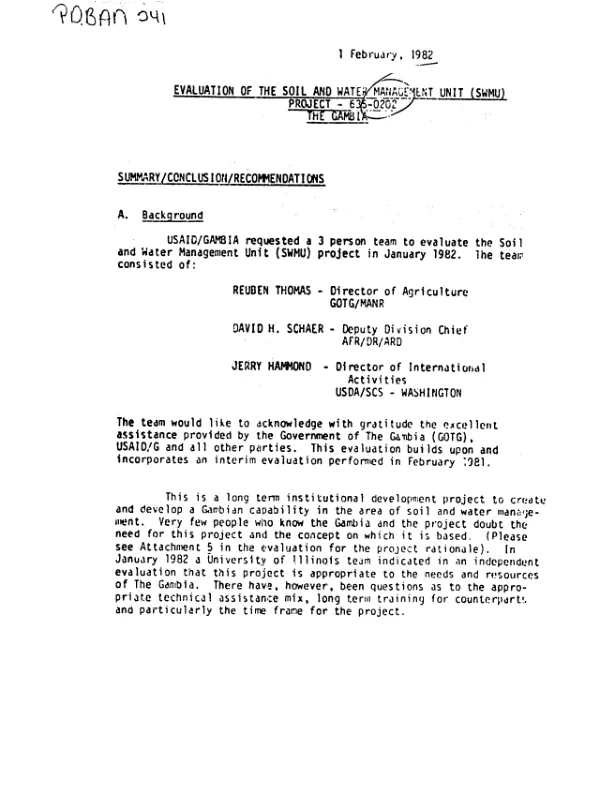
As a result of the decline of The Gambia's natural resource base, USAID supported three major sustainable agricultural development activities -- soil and water management, mixed farming and range management, and agricultural research and diversification -- totaling $30.3 million between 1978 and 1992.
McClelland, Donald G.|Hall, Robert E. · 1994
Sign in to readA free account is required to download.
Abstract
Of these, the $4.96 million Soil and Water Management (SWM) project had the most direct and dramatic results in environmental, economic, and social terms. The SWM program rehabilitated lowland rice soils and protected them from salinization, while also protecting upland slopes from erosion and nearby villages from flooding. As a result, saline soils that were gradually becoming uncultivable could be cultivated again; crop yields (primarily rice) increased significantly (often doubling in the first year after protective measures were applied); water tables rose; and soil and gully erosion was reduced. Because women are typically the rice growers in The Gambia, they were among the major beneficiaries. The program was also effective in that it reached its target population, provided equal opportunity to all potential beneficiaries, and is expected to return $5 for every $1 spent between 1992 and 2006. SWM success can be attributed to four main factors. (1) The conservation technologies that USAID introduced produced significant results in a short time and thus led to high adoption rates. (2) The demand for technologies originated with beneficiaries, not with donors or government. (3) Institution building at the national level and participation at the local level were emphasized. (4) The new technologies were simple to implement, easy to maintain, and required few changes in farmers' existing practices. The SWM Unit which A.I.D. created and sustained over 13 years is a strong institution that is sustainable as long as it receives adequate budgetary support. The project is replicable given continued access to the technical design expertise currently provided by the Unit, although there remains a critical shortage of management skills on the part of senior and mid-level Gambian officials.
![Supporting sustainable and profitable agriculture : lessons learned from mid-term review of CLUSA/NRMP and WVIAP [Cooperative League of the USA/natural resources management project and World Vision integrated agro-forestry project] in Eastern Province, Zambia](https://covers.devme.ai/gen/5298.webp)