GOVERNMENT OF TAJIKISTAN
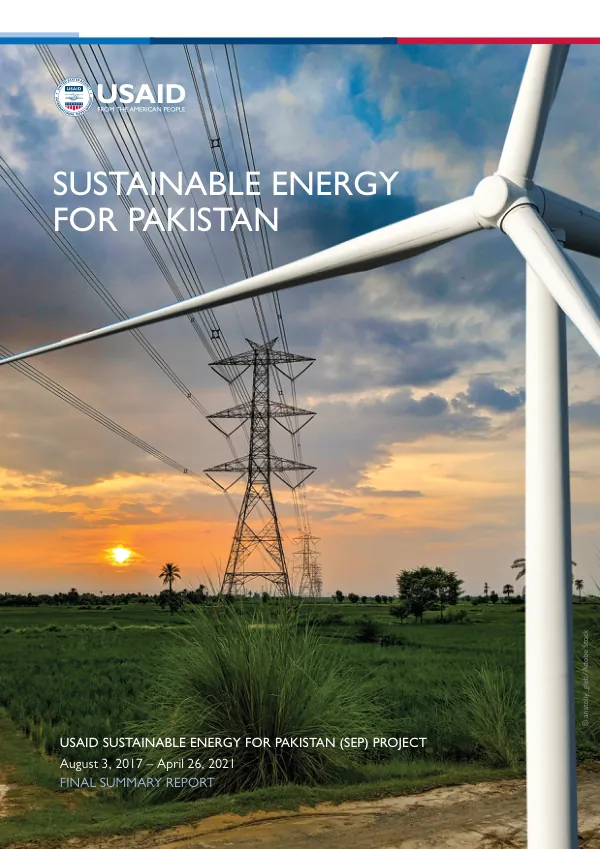
Sustainable Energy for Pakistan Project: Final Summary Report
The Sustainable Energy for Pakistan (SEP) project was a flagship initiative of the U.S.
2021 · 12 pages
Sign in to readA free account is required to download.
Abstract
Agency for International Development (USAID) that aimed to increase the financially sustainable delivery of energy services for economic and social development in Pakistan. The project was launched in August 2017 and concluded in April 2021. Pakistan's electricity sector has faced significant challenges, including electricity shortfalls and load shedding. To address these issues, the Government of Pakistan accelerated the rate of addition of new capacity, resulting in a growth rate of 60 percent in six years. However, this new capacity came with its own challenges, including high distribution losses and a mounting circular debt. Through the SEP project, USAID supported the Government of Pakistan's efforts to increase private investment in clean energy projects, improve the capacity of the transmission system and energy markets, enhance the commercial viability of the electricity distribution subsector, and improve sector governance through policy reforms. The project also aimed to increase the share of renewables in the energy mix and support the creation of an attractive business environment for private investment. The SEP project achieved several key results, including the financial closure of 12 wind power projects and four solar power projects that will provide 860 MW of renewable energy for Pakistan's national power grid. The project also mobilized $922.6 million of public and private sector investment in clean energy projects. Additionally, the project improved the technical capacity of 1,472 individuals across the power sector, including those representing the national transmission system operator, market operator, distribution utilities, and government ministries. The project also focused on digitalizing energy systems, which is critical to providing reliable service to consumers. The country's outdated network infrastructure, lack of adequate system planning, high technical and commercial losses, and financial accounting inefficiency across the value chain pose significant challenges to sector performance. Through targeted investments in digital infrastructure, the project built local capacity in the use of advanced analytical tools and techniques and bolstered the sector's commercial viability. The project's results include the procurement and installation of 7,961 advanced metering infrastructure (AMI) smart meters for PESCO and Multan Electric Power Company (MEPCO). The project also designed and established an integrated AMI platform that enables distribution companies to purchase smart meters from multiple vendors and accelerate deployment of digital AMI systems to reduce losses, improve revenue collection, and conduct effective load management. Furthermore, the project procured and installed 100 high-accuracy smart meters and related communications equipment at the National Transmission and Despatch Company (NTDC) and the market operator (CPPA-G), marking Pakistan's transition from manual to digital electricity data. The project also established a model subdivision at PESCO by replacing existing meters with digital smart meters, removing illegal taps, upgrading 150 km of aerial bundle conductor cables, and installing 334 asset performance management system units at distribution transformers to protect the system from overload. Additionally, the project established a smart grid integration and testing lab at WAPDA House Lahore, empowering testing and certification and integration compliance of smart grid devices. The project also equipped the Central Power Purchasing Agency-Government (CPPA-G) with PLEXOS to enable modern planning and verification. Overall, the SEP project has made significant contributions to the development of Pakistan's energy sector, including increasing private investment in clean energy projects, improving the capacity of the transmission system and energy markets, and digitalizing energy systems. The project's results have the potential to improve the reliability and efficiency of the energy sector, ultimately benefiting the people of Pakistan.
Related documents