USAID. MISSION TO ECUADOR
Sustainable uses for biological resources (SUBIR)
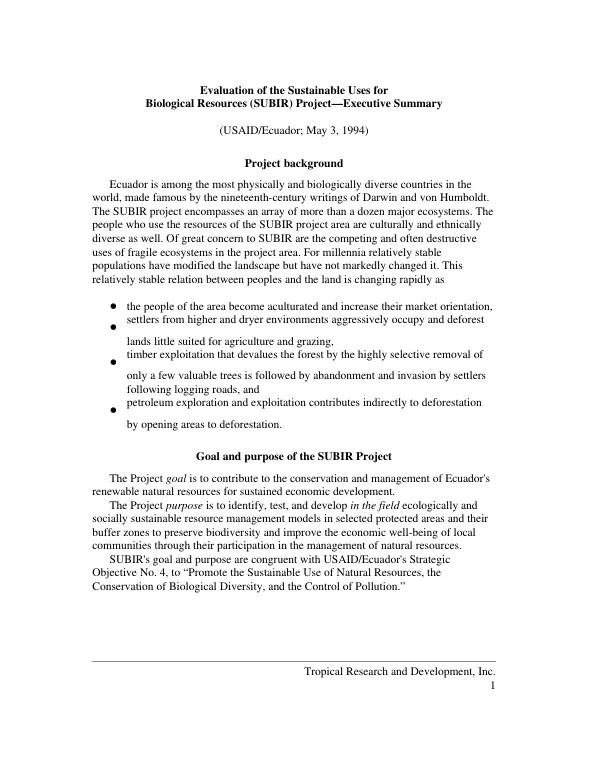
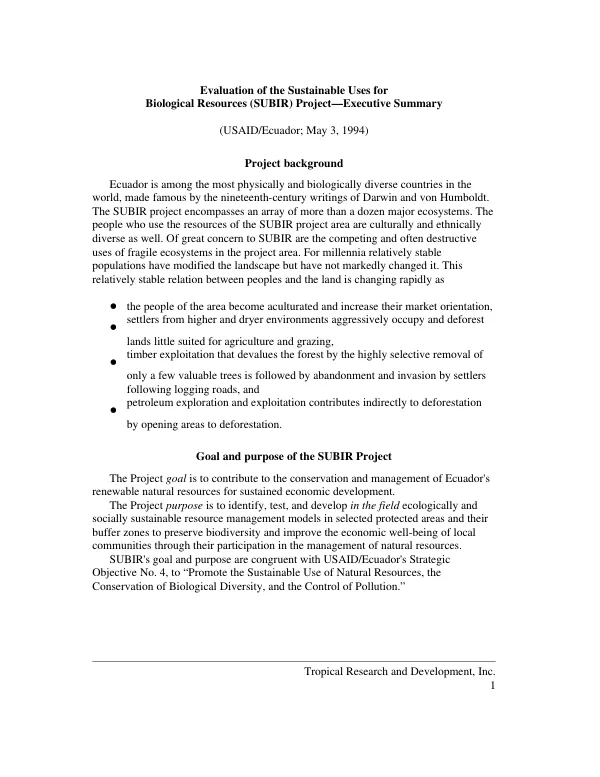
Project to develop sustainable community-based models for managing natural resources in Ecuador that preserve biodiversity while improving the economic well-being of local communities.
1970
Sign in to readA free account is required to download.
Abstract
The project will be implemented by a PVO consortium (CARE, The Nature Conservancy, and Wildlife Conservation International) in cooperation with the Ministry of Agriculture"s Subsecretariat for Forestry, Natural Resources, and Wildlife (SUFOREN) at three sites: Yasuni National Park, Cayambe-Coca Ecological Reserve, and Cotacachi-Cayapas Ecological Reserve (and their buffer zones). Activities will include: organizational development; protected areas management; ecotourism; sustainable use of buffer zone resources; and research. The project will provide training and TA to improve the resource management capacities of community, NGO, regional, and national organizations. Focus will be on the local level, where community leaders (mestizos, blacks, and indigenous peoples) will be trained to develop and implement natural resource conservation and utilization projects. At the regional and national levels, Interorganizational Coordinating Committees, made up of public, private, and community representatives, will facilitate collaboration between resource users and developers, and resolution of resource-use conflicts. Management of protected areas will be improved in several ways. Resource management plans, based on "Man and the Biosphere" concepts,will be developed. The boundaries of the reserves will be defined and, in areas of actual or potential incursion, physically demarcated. Park guards and selected community leaders will be trained in ecology, park management, and conservation, and additional guards will be hired. New infrastructure, such as administrative and tourist facilities, and field equipment will be provided to support park administration, ecotourism, and research. Community networks, reinforced by new legal mandates, will be established to detect and report destructive activities. The project will develop community-based tourism programs, including an ecotourism interpretation center at each site; the Peace Corps will assist in this effort. Activities will include training of tourist guides and local personnel and the use of various media to promote ecotourism. The communities will help to develop and operate the ecotourism programs, and will participate in the economic benefits. Community-based sustainable resource use packages will be tested in buffer zones. Activities will include: forest inventories and harvesting plans; agroforestry; intensification and diversification of land use; upgrading of perennial and annual crops; soil conservation practices; and pilot projects in processing and marketing forest products. Research will include: baseline surveys and inventories; ethnobotanical research to identify new plant species and alternative uses of resources; applied research in agriculture and forestry; and socioeconomic research to analyze land-use conflicts and identify sustainable management systems. Major activities will be carried out by NGOs and smaller ones funded through grants. The project will train Ecuadorian biologists and social scientists in field research and will disseminate findings widely. Trainees in the five project components will number 210, 180, 69, 2000, and 60 respectively. Pro-Ag Amendment of 9/21/94 finances TA to help the Ecuadorian Environmental Commission (CAAM) to develop and implement parts of the national Environmental Action Plan (EAP). The EAP, which will be the fruit of a public/private planning process involving 8 regional seminars/workshops, will include (1) strategies for managing fragile ecosystems, nonrenewable natural resources, and urban pollution, and (2) action programs to combat urban pollution, protect biodiversity, reduce deforestation, and develop petroleum on a sustainable basis. Other activities will include support for: the 2/95 Second National Conference on the Environment; community participation in EAP development; efforts to resolve Taura Syndrome, especially in the Gulf of Guayaquil; and CAAM"s institutional development. (PD-ABJ-905) Pro-Ag amendment of 5/26/95 adds 4 training courses in environmental impact assessment (EIA) for public and private environmental units in Guayaquil, Quito, and Cuenca. At least 22 people will be trained per course. (PD-ABL-963) Pro-Ag amendment of 7/26/95 adds the following activities: creation of standardized EIA and monitoring methodologies and their application in at least 50% of EIAs; workshops and promotional events aimed at integrating environmental and development policies; and special programs, including development of an oil clean-up trust fund, a natural resources law, and pesticide management policies. (PD-ABL-964) Pro-Ag Amendment of 9/10/96 adds activities to: (1) continue EIA training and widely disseminate the rules and regulations of the National EIA System; (2) continue with the consolidation of the NEAP in three additional key sectors (road transportation, water resources, and international trade and the environment); (3) continue supporting various programs and projects, such as passing the Environmental Law in Congress, the Oil Clean-up Trust Fund, the National Environmental Fund, and training on use of agrochemical substances. (PD-ABN-243)