TETRA-TECH, INC.
Sustainable Water Partnership (SWP): An Integrated Approach
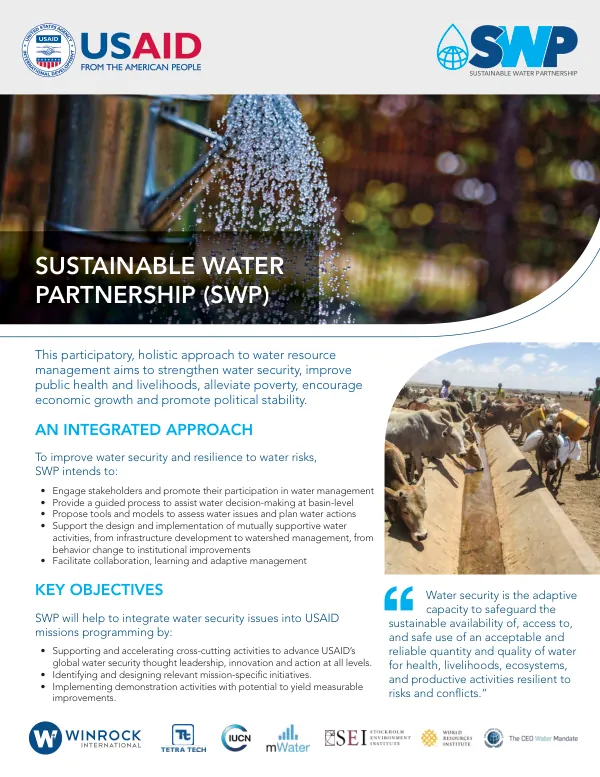
Water security is the adaptive capacity to safeguard the sustainable availability of, access to, and safe use of an acceptable and reliable quantity and quality of water for health, livelihoods, ecosystems, and productive activities resilient to risks and conflicts.
2017 · 2 pages
Sign in to readA free account is required to download.
Abstract
The impact of water on development is significant, with a safe drinking water supply, sanitation, management of water resources, and improvement of water productivity capable of improving the lives of millions. The Sustainable Water Partnership (SWP) aims to strengthen water security through a participatory approach that engages stakeholders and promotes their participation in water management. SWP will provide a guided process to assist decision-making at the basin level, propose tools and models to assess water issues and plan water actions, and support the design and implementation of mutually supportive water activities. These activities will include infrastructure development, watershed management, behavior change, institutional improvements, and collaboration, learning, and adaptive management. SWP will also support USAID missions in integrating water security issues into their programming. This will be achieved through the identification and design of relevant initiatives, the implementation of demonstration activities, and the acceleration of cross-cutting activities to advance USAID's global water security thought leadership, innovation, and innovation at all levels. The SWP team will provide technical expertise and experience to USAID missions and government counterparts, including TetTech, International Union for Conservation of Nature (IUCN), the Stockholm Environmental Institute (SEI), the World Resources Institute (WRI), the mWater, and the USAID Agreement Officer Representative. The SWP will focus on promoting water security through pilot activities at strategic or demonstration levels. This will involve the development of tools and models to assess water issues and plan water actions, as well as the support of the design and implementation of mutually supportive water activities. The SWP will also facilitate collaboration, learning, and adaptive management among stakeholders, and will support the integration of water security issues into USAID missions programming. The SWP will be implemented over a five-year period, with the goal of improving water security and promoting economic growth, alleviating poverty, and promoting public health and stability. The SWP will also aim to strengthen the adaptive capacity of water resources, improve public health, and alleviate poverty, and will provide a safe drinking water supply, sanitation, management of water resources, and improvement of water productivity to millions of people.
Related documents