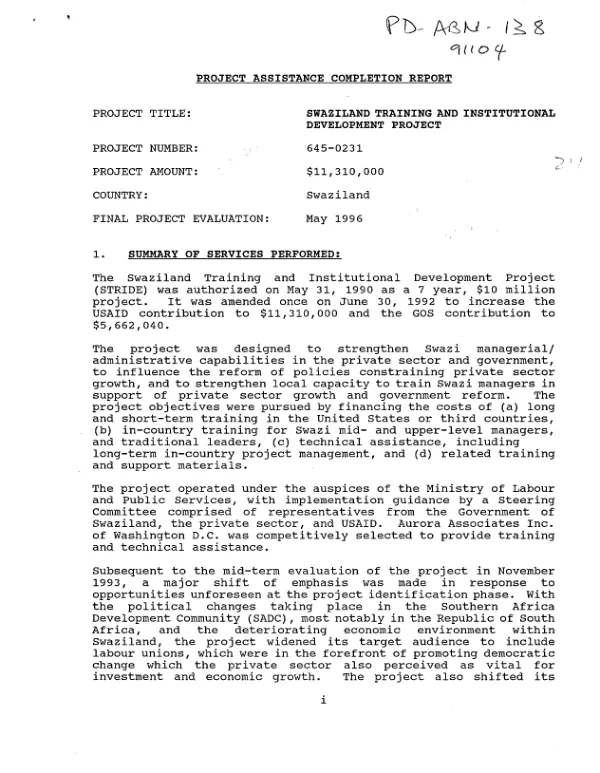
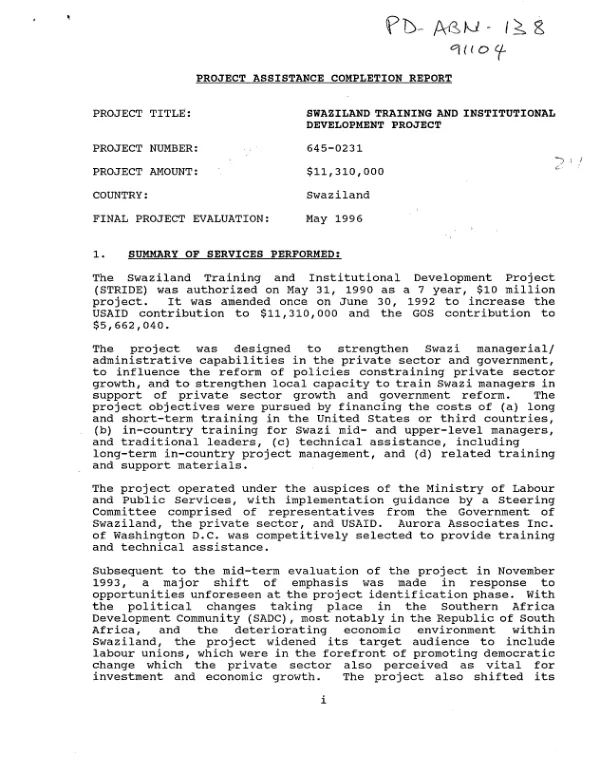
USAID. MISSION TO SWAZILAND
Swaziland manpower development project (SWAMDP)
Summarizes mid-term evaluation (not attached) of a project to increase the capacity of select Swazi institutions to plan and implement development activities.
1990
Sign in to readA free account is required to download.
Abstract
The evaluation covered the period FY84-88. The status of the project"s five components is as follows. (1) The technology transfer component has made less than optimal use of technical advisors, and at current rates of utilization a significant amount of the budgeted TA will not be used. USAID/S needs to review and take action on both the long- and short-term functions of OPEXer"s. (2) Most participant training activities are either on track or exceeding planned targets. Long-term training to develop an administrative cadre is the most successful project element and will exceed target in terms of number of participants. Student support services are well received, although some participants have had difficulty in securing housing, and the Government of Swaziland allowance for dependents is insufficient. In-country training, on the other hand, has been very poorly implemented and is behind schedule. A contractor strategy for in-country training is needed. (3) Training seminars and workshops for traditional leaders and women"s organizations have been well planned, appropriate, and very popular. Moreover, the number of workshop participants has exceeded the planned output. The impact of the training on community development should be assessed. (4) The development communications component has increased the number and quality of development messages, with nearly 60% of radio programming containing such themes. Although the Swaziland Broadcasting Service failed to set up a planned Centre for Development Communication, the University of Swaziland has been identified as a more appropriate training institution. (5) Progress in building institutional linkages has been modest, with only one of a projected five U.S. institutions developing ties to a Swazi institution. In this case, however, the linkage has proved fruitful to the Swazi institution. Project management has suffered from poor continuity between advisors. It is recommended that the role of Project Management Officer be increased from 50% to a 100% dedicated slot. The most important long-term issue is whether to split a successor project into component parts or maintain the current project"s umbrella approach. USAID/S should carefully weigh the pro"s and con"s of both approaches.