USAID. MISSION TO SWAZILAND
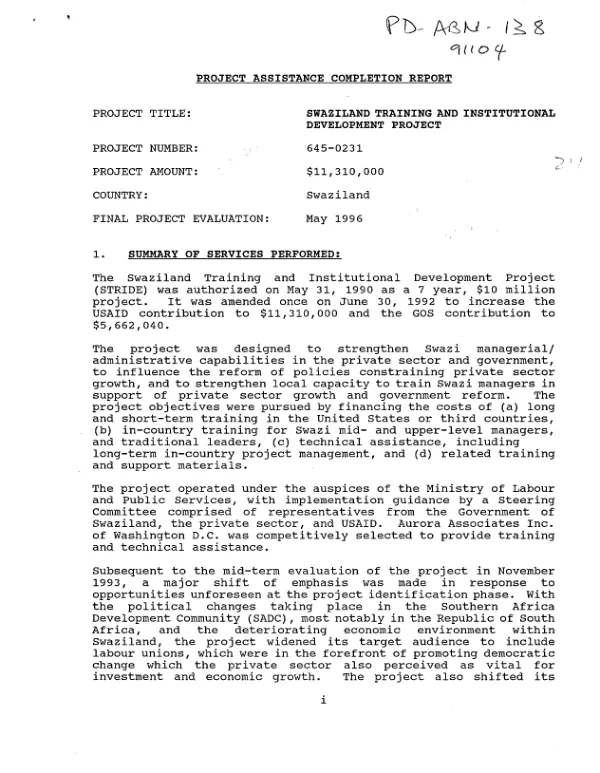
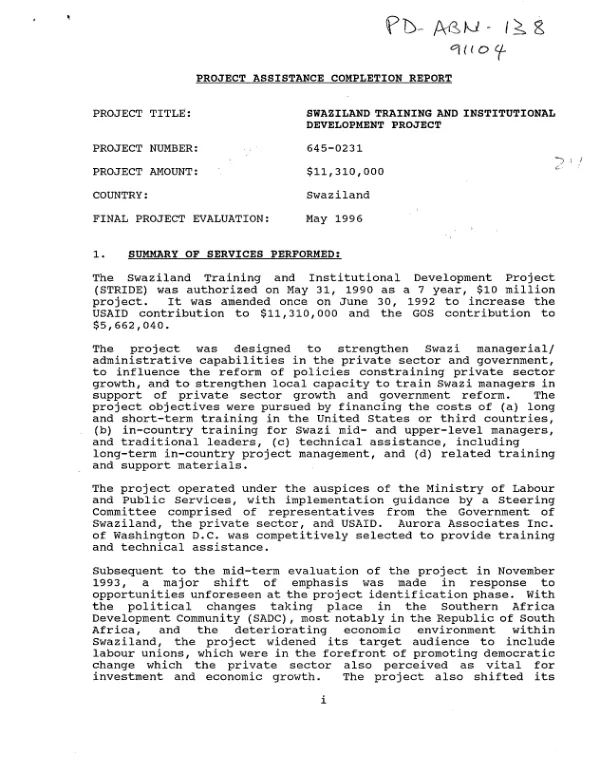
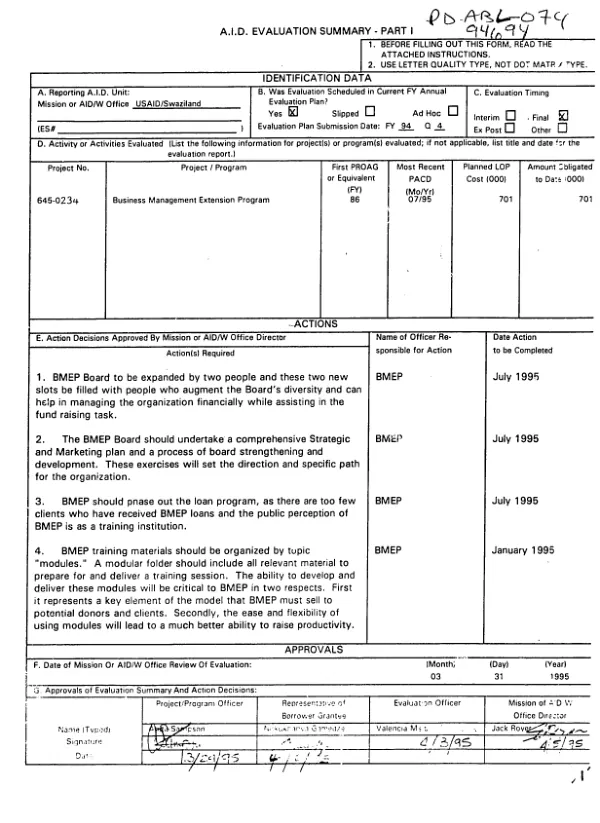
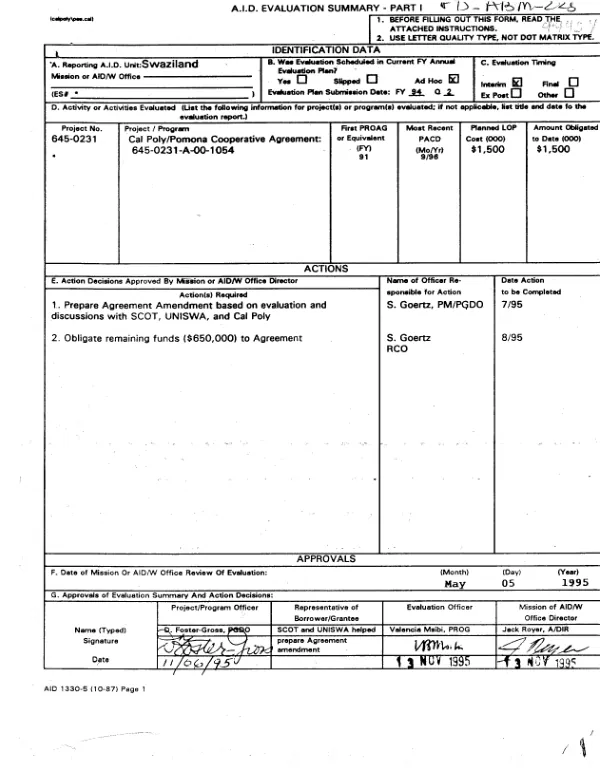
Cal Poly/Pomona cooperative agreement 645-0231-A-00-1054
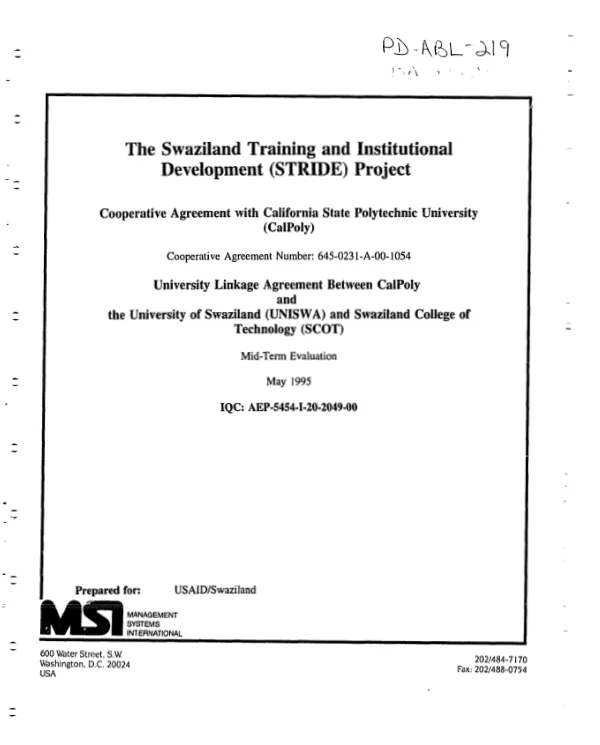
Summarizes an ad hoc interim external evaluation of a cooperative agreement with California State Polytechnic University/Pomona (Cal Poly) for a project to upgrade the Faculty of Commerce of the University of Swaziland (UNISWA) and Swaziland College of Technology (SCOT).
1995
Sign in to readA free account is required to download.
Abstract
The evaluation was conducted in response to perceived problems in the project, and covers the period 1991-5/95. Managerial, cross-cultural, public relations, and communications problems among Cal Poly, SCOT, and UNISWA have limited the project"s progress. Aspects of true cooperation have been missing, e.g., mutuality of interest among all participants, assumption of an equal planning role by Swazi institutions, and efforts to assure long-term institutional relationships. Additionally, UNISWA and SCOT have failed to fully institutionalize new curricular methods and policies, and Cal Poly has failed to provide regular monthly financial reports and semi-annual technical reports. Nonetheless, the project can point to several accomplishments. Professional levels of Swazi faculty have significantly improved, and there is an indication that student competencies are being enhanced. Short-term TA has improved the business management, marketing, and accounting curricula, and there has been some progress in implementing new pedagogical methods such as student-centered learning and competency-based teaching. At the time of evaluation, two Swazis had successfully completed degree training at Cal Poly, with three others still in training. Also, Computer equipment has been procured and is being utilized. The following lessons have been learned. (1) Short-term U.S. faculty visits to Swazi institutions can be effective if Statements of Work are developed collaboratively, specific Swazi counterparts are assigned, timing and teaching schedules are coordinated, instructive literature is left behind, and communications continue between faculty on both continents. In this project, several months of short-term consulting time were combined to allow one CalPoly professor to conduct linkage activities at UNISWA and SCOT for a year, with UNISWA providing matching funding to allow him to teach several classes in place of faculty being trained at CalPoly. This arrangement proved very effective. (2) One reason for the project"s shortcomings in cooperation is that the project design did not specifically address ways for CalPoly, UNISWA, and SCOT to extend linkages when USAID support ends. (3) USAID should budget for an interim external evaluation for linkage projects. This evaluation, originally unplanned for, proved extremely valuable. (4) Local institutions need to be committed to taking advantage of and integrating new teaching concepts introduced by a U.S. university. It does little good if new methodologies introduced by visiting faculty or by local faculty returning from the U.S. are not accepted by the local administration.
Related documents
Documents in this collection
 1995
1995USAID DEC
Swaziland training and institutional development (STRIDE) project -- cooperative agreement with California State Polytechnic University (CalPoly), cooperative agreement number 645-0231-A-00-1054 -- university linkage agreement between CalPoly and the University of Swaziland (UNISWA) and Swaziland College of Technology (SCOT) : mid-term evaluation
Open record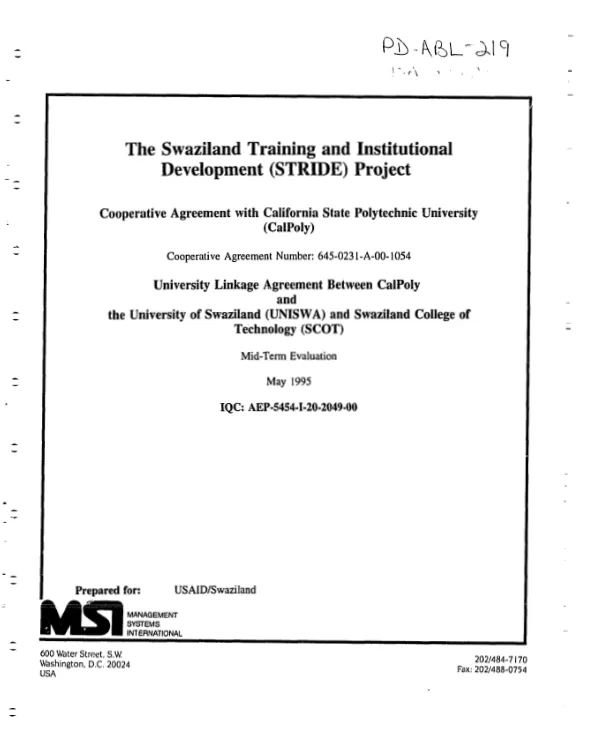 1995
1995