U.S. DEPT. OF HEALTH AND HUMAN SERVICES. PUBLIC HEALTH SERVICE. OFC. OF INTERNATIONAL HEALTH
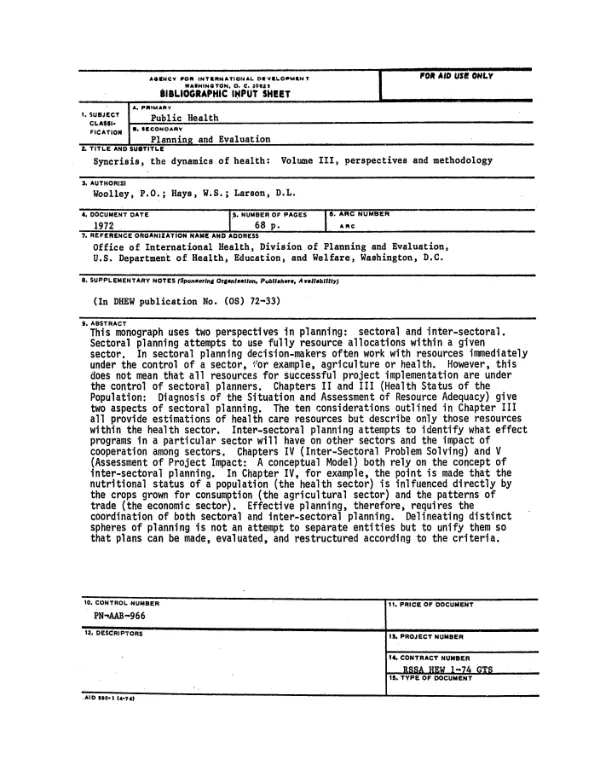
Syncrisis, the dynamics of health : 3. perspectives and methodology
This monograph uses two perspectives in planning: sectoral and inter-sectoral.
Woolley, P. O.; Hays, W. S. +1 more · 1970
Sign in to readA free account is required to download.
Abstract
Sectoral planning attempts to use fully resource allocations within a given sector. In sectoral planning decisionmakers often work with resources immediately under the control of a sector, for example, agriculture or health. However, this does not mean that all resources for successful project implementation are under the control of sectoral planners. Chapters II and III (Health Status of the Population: Diagnosis of the Situation and Assessment of Resource Adequacy) give two aspects of sectoral planning. The ten considerations outlined in Chapter III all provide estimations of health care resources but describe only the resources within the health sector. Inter-sectoral planning attempts to identify what effect programs in a particular sector will have on other sectors and the impact of cooperation among sectors. Chapters IV (Inter-Sectoral Problem Solving) and V (Assessment of Project Impact: A conceptual Model) both rely on the concept of inter-sector) is influenced directly by the crops grown for consumption (the agricultural sector) and the patterns of trade (the economic sector). Effective planning, therefore, requires the coordination of both sectoral and inter-sectoral planning. Delineating distinct spheres of planning is not an attempt to separate entities but to unify them so that plans can be made, evaluated, and restructured according to the criteria.