MERCY CORPS INTERNATIONAL
Taiz Emergency Food Program 3rd QUARTERLY REPORT
The Taiz Emergency Food Program (TEFP) was initially designed to be implemented over a period of eleven months in four districts targeting 72,000 households.
2012 · 6 pages
Sign in to readA free account is required to download.
Abstract
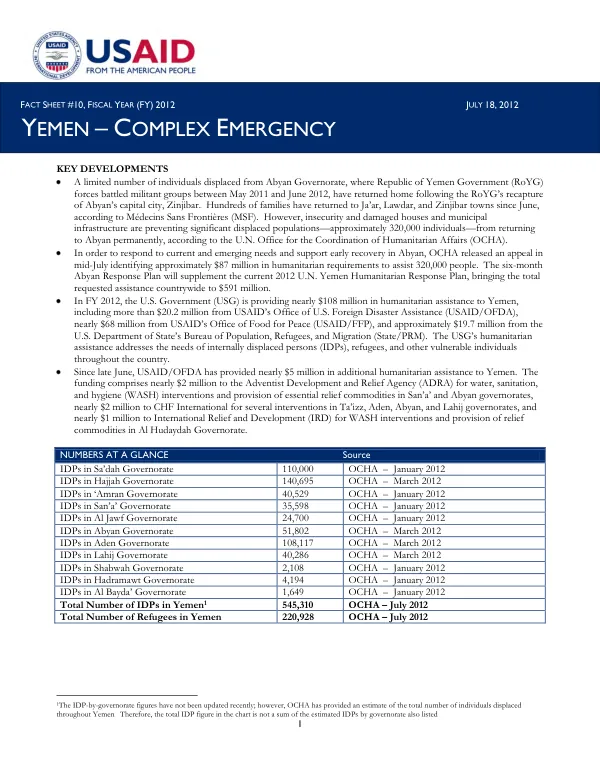
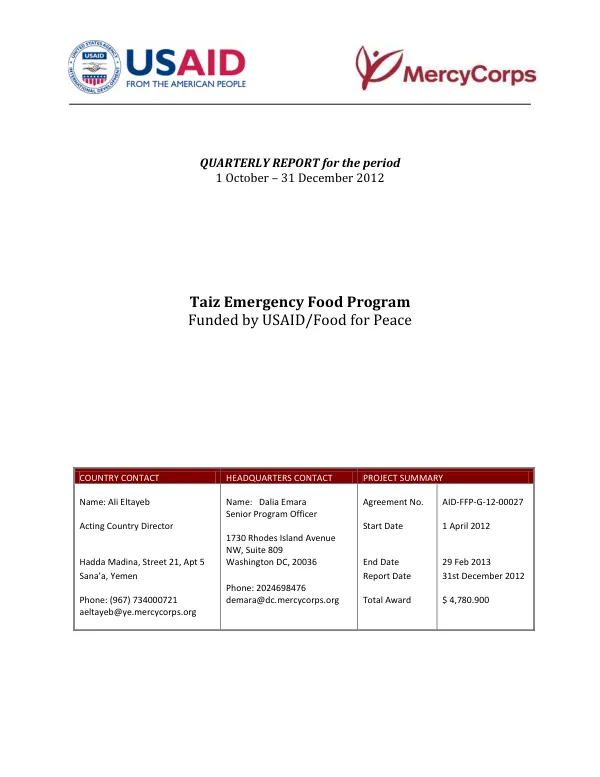
However, the project currently operates in three districts and expects to run through the end of May 2013, targeting a total of 8,965 households. The project is providing eight months of food commodities to households through a voucher system in the three districts. The three districts are among the areas identified as having high nutritional gaps as a result of political and economic shocks in Yemen. The main objective of the project is to increase food security for 50,400 individuals in 7,200 vulnerable households in Dhubab, Al Waziiyah, Al Mokha, and Mawza Districts of Taiz Governorate, Yemen through eight months of targeted emergency food rations during the political transition. The project has three main expected results: identifying 7,200 households that meet the vulnerability and food insecurity criteria, redeeming 8 months of commodity vouchers by 7,200 households, and increasing household food availability for 7,200 households. During the third quarter, an additional 1,993 vulnerable households (about 13,951 beneficiaries) were identified, verified, and included in the registry. The newly registered beneficiaries, in addition to the existing 6,953 beneficiary households, brings the total number of beneficiary households to 8,946. Beneficiaries received two months of food commodity vouchers covering the months of October and November 2012, exceeding the original target of 7,200 households. A total of 8,946 households (75,981 beneficiaries) received food commodity vouchers each of the two months. The baseline survey collected data on the extent of food insecurity in the three project districts and the coping mechanisms of households in response to the situation. Findings from the baseline survey indicated that food insecurity, in combination with poverty, caused households in the three districts to employ coping strategies that undermine their future. The mean CSI for the three districts was calculated at 93, and the HFIAS Score was 13.5 on a scale of 0-27. The baseline survey also collected data on nutrition knowledge, attitude, and practice (KAP) survey, which began in September 2012 and was concluded in the third quarter. The TEFP/FFP Project has a robust monitoring mechanism in place to identify and respond to irregularities. There is also a grievance/complaint mechanism in place whereby beneficiaries, non-beneficiaries, and other concerned persons can report any observed or perceived fraud or irregularity to Mercy Corps. The system has proven to be very successful. The project also collected market prices for the four commodities in the food basket, which will help to inform future program design and implementation. The project has made significant progress in achieving its objectives, including identifying and targeting vulnerable households, redeeming commodity vouchers, and increasing household food availability. The project's monitoring and evaluation activities have also been successful, providing valuable data on the project's impact and effectiveness. The project's extension for an additional three months, pending USAID approval, will allow for further progress towards achieving its objectives.
Related documents