INTERNATIONAL CHILDREN'S FUND, INC.
Yemen Complex Emergency FS#3 12-28-2011
Humanitarian needs persist throughout Yemen due to ongoing conflict and displacement.
2011 · 5 pages
Sign in to readA free account is required to download.
Abstract
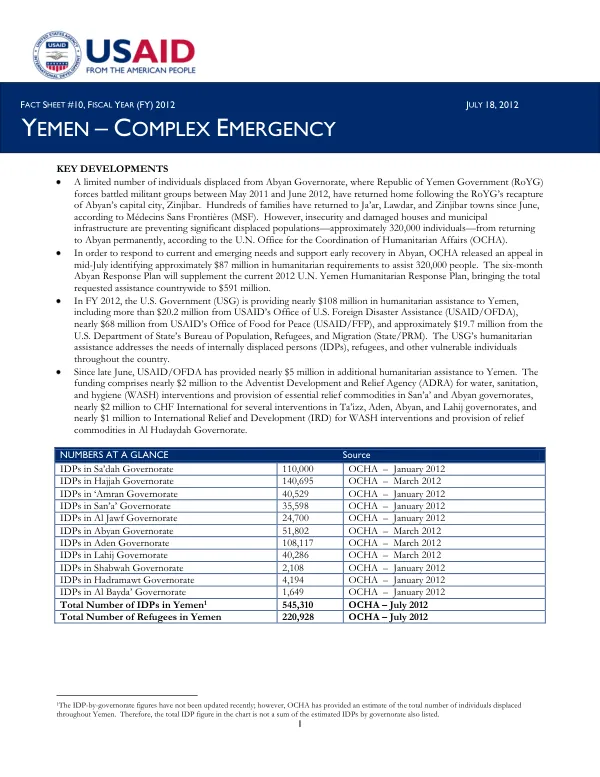
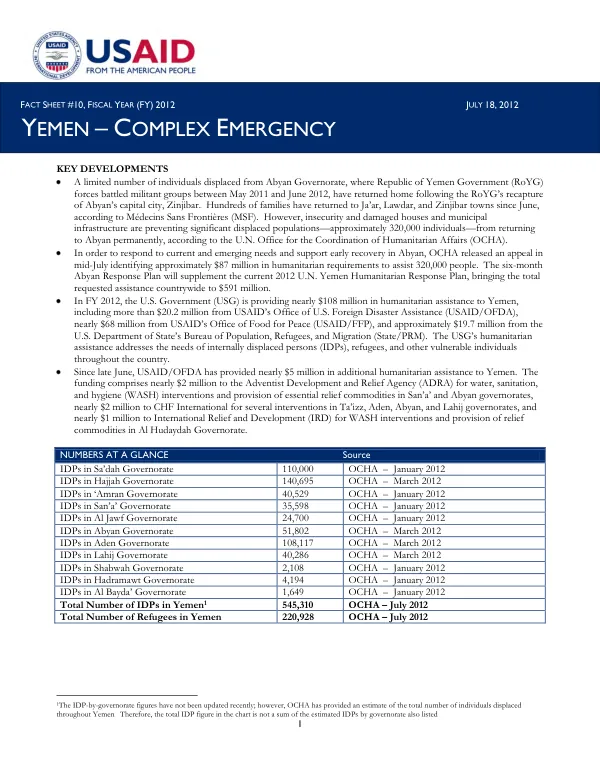
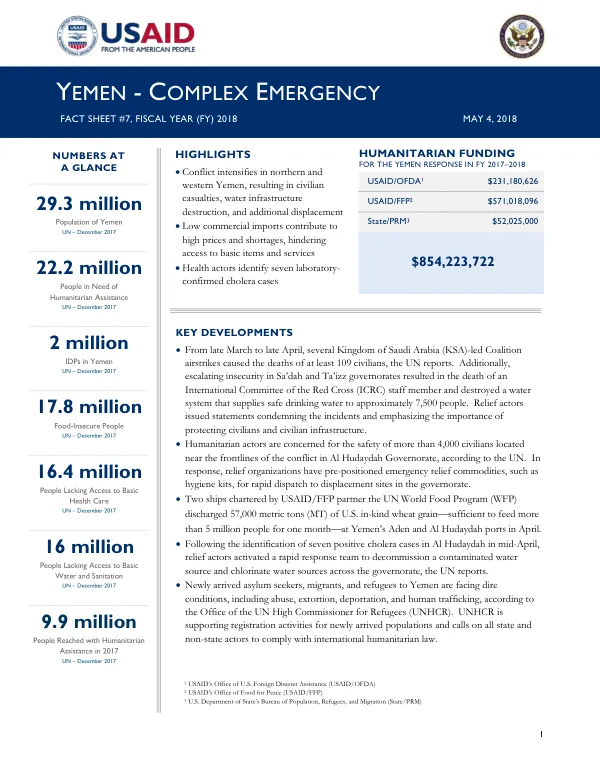
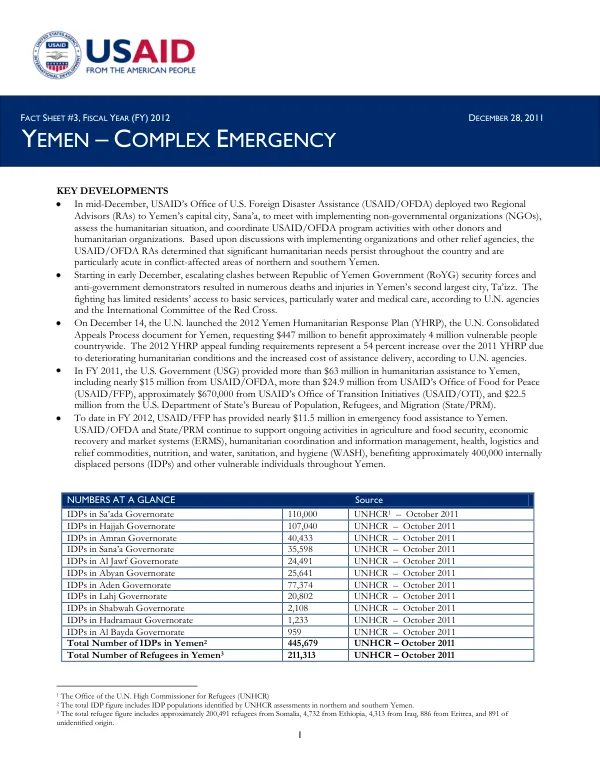
Escalating clashes between Republic of Yemen Government (RoYG) security forces and anti-government demonstrators resulted in numerous deaths and injuries in Ta'izz, Yemen's second largest city. The fighting has limited residents' access to basic services, particularly water and medical care, according to U.N. agencies and the International Committee of the Red Cross. The U.N. launched the 2012 Yemen Humanitarian Response Plan (YHRP) on December 14, requesting $447 million to benefit approximately 4 million vulnerable people countrywide. The 2012 YHRP appeal funding requirements represent a 54 percent increase over the 2011 YHRP due to deteriorating humanitarian conditions and the increased cost of assistance delivery, according to U.N. agencies. In FY 2011, the U.S. Government provided more than $63 million in humanitarian assistance to Yemen, including nearly $15 million from USAID's Office of Foreign Disaster Assistance (USAID/OFDA), more than $24.9 million from USAID's Office of Food for Peace (USAID/FFP), and $22.5 million from the U.S. Department of State's Bureau of Population, Refugees, and Migration (State/PRM). To date in FY 2012, USAID/FFP has provided nearly $11.5 million in emergency food assistance to Yemen. USAID/OFDA and State/PRM continue to support ongoing activities in agriculture and food security, economic recovery and market systems (ERMS), humanitarian coordination and information management, health, logistics and relief commodities, nutrition, and water, sanitation, and hygiene (WASH), benefiting approximately 400,000 internally displaced persons (IDPs) and other vulnerable individuals throughout Yemen. The total number of IDPs in Yemen is approximately 445,679, according to the Office of the U.N. High Commissioner for Refugees (UNHCR). The majority of IDPs are concentrated in northern and southern Yemen, with significant numbers in Sa'ada, Hajjah, Amran, and Al Jawf governorates. In addition to IDPs, Yemen hosts a significant number of refugees, the majority from the Horn of Africa, who are also experiencing critical humanitarian needs. U.N. agencies anticipate a continued influx of refugees into Yemen as drought conditions and insecurity worsen in Somalia. Preliminary nutrition findings from an assessment conducted in October by USAID/OFDA partner the U.N. Children's Fund (UNICEF) in western Yemen's Al Hudaydah Governorate indicate a global acute malnutrition (GAM) prevalence of 31.7 percent, exceeding the internationally accepted GAM emergency threshold of 15 percent. U.N. agencies have registered similarly high levels of acute malnutrition in southern Yemen's Aden and Lahj governorates. In response to ongoing health needs, USAID/OFDA and USAID/OTI support the International Organization for Migration (IOM) and NGOs to conduct medical screening, treatment, and vaccination activities through mobile health clinics and other flexible and targeted health interventions. WASH needs among conflict-affected and vulnerable individuals throughout Yemen persist due to insecurity and prolonged displacement. With ongoing FY 2011 funding, USAID/OFDA partner UNICEF continues to address the emergency WASH needs of IDPs and other vulnerable individuals in northern Yemen, providing safe drinking water to nearly 10,000 individuals in Amran Governorate and rehabilitating six IDP camp water points in Hajjah Governorate.