USAID FAMINE EARLY WARNING SYSTEMS NETWORK
TAJIKISTAN Remote Monitoring Update January 2015
The agricultural sector in Tajikistan is a significant contributor to the country's economy, with the majority of households relying on agriculture for their livelihood.
2015 · 2 pages
Sign in to readA free account is required to download.
Abstract
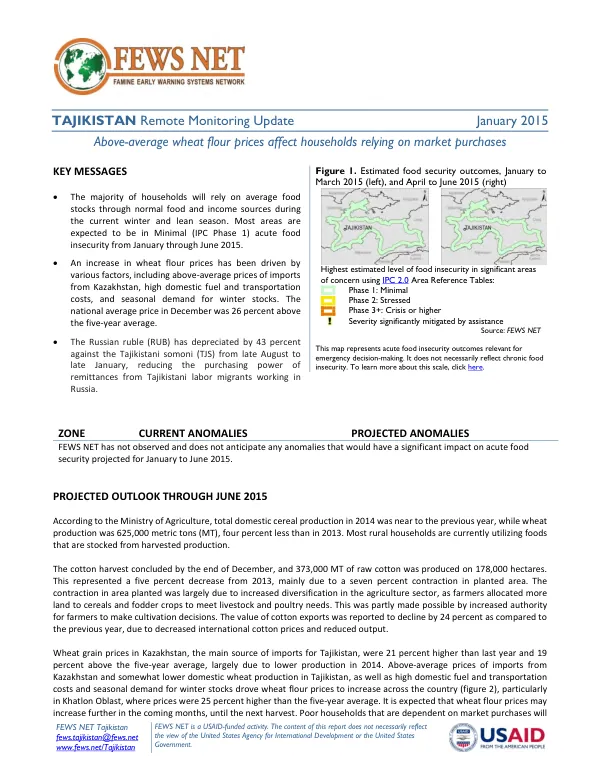
The country's remote monitoring update for January 2015 indicates that above-average wheat flour prices are affecting households that rely on market purchases. The national average price of wheat flour in December 2014 was 26 percent above the five-year average, driven by various factors including above-average prices of imports from Kazakhstan, high domestic fuel and transportation costs, and seasonal demand for winter stocks. The Russian ruble has depreciated by 43 percent against the Tajikistani somoni from late August to late January, reducing the purchasing power of remittances from Tajikistani labor migrants working in Russia. Remittances constitute a significant source of income for many households in Tajikistan, and the decline in remittances has been mainly due to the depreciation of the Russian ruble against international currencies. Economists speculate that further depreciation of the ruble or even stabilization at its current value would continue to adversely affect those countries that rely heavily on remittances from Russia, including Tajikistan. According to the Ministry of Agriculture, total domestic cereal production in 2014 was near to the previous year, while wheat production was 625,000 metric tons, four percent less than in 2013. Most rural households are currently utilizing foods that are stocked from harvested production. The cotton harvest concluded by the end of December, and 373,000 metric tons of raw cotton were produced on 178,000 hectares, representing a five percent decrease from 2013. The contraction in area planted was largely due to increased diversification in the agriculture sector, as farmers allocated more land to cereals and fodder crops to meet livestock and poultry needs. Wheat grain prices in Kazakhstan, the main source of imports for Tajikistan, were 21 percent higher than last year and 19 percent above the five-year average, largely due to lower production in 2014. Above-average prices of imports from Kazakhstan and somewhat lower domestic wheat production in Tajikistan, as well as high domestic fuel and transportation costs and seasonal demand for winter stocks, drove wheat flour prices to increase across the country. Poor households that are dependent on market purchases will be particularly affected, and prices for potatoes, another staple food, have also increased since September 2014 in major markets. The majority of households are expected to cover basic food and non-food needs during this winter from normal food and income sources. Most areas will be in Minimal (IPC Phase 1) acute food insecurity from now through June 2015. However, urban households and net purchasers of wheat flour in rural areas will face constraints on purchasing power due to elevated prices of wheat and wheat flour in markets. The cumulative precipitation from October through January has been significantly higher than last year in most parts of the country, but most areas have still received below-average precipitation, particularly in Gorno-Badakhshan Autonomous Oblast (GBAO).
Related documents