UNIVERSITY OF MISSOURI AT COLUMBIA
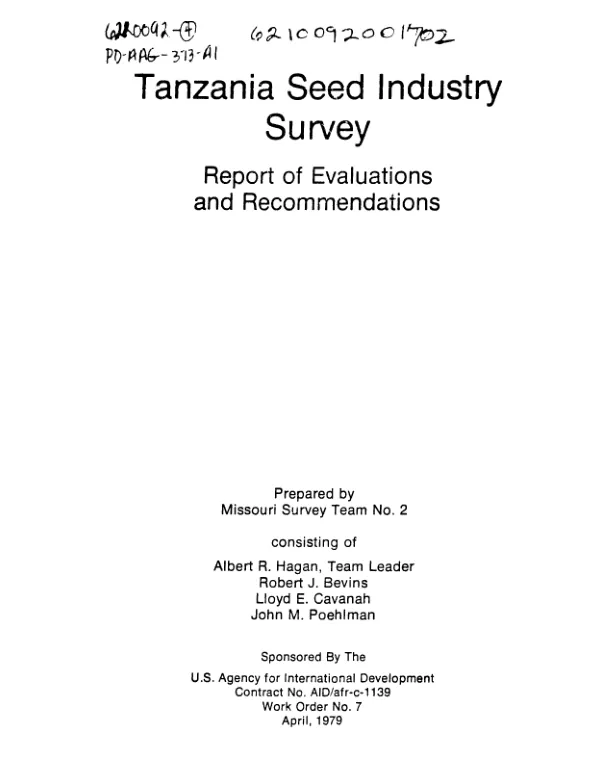
TANZANIA SEED INDUSTRY SURVEY - REPORT OF EVALUATIONS AND RECOMMENDATIONS
Evaluates project to increase seed production in Tanzania.
HAGAN, ALBERT R.|BEVINS, ROBERT J. · 1979
Sign in to readA free account is required to download.
Abstract
This special evaluation covers the period 1/1/70-4/1/79 and is based on onsite visits and discussions with project personnel. Tanzania's seed industry, like that of most developing countries, acquires the majority of its seed from previous plantings. Commercial seed is also used, but its quality from the standpoint of purity and germination is often questionable. The Tanzanian seed industry consists of five major components: research development of breeder seed; the expansion of pure lines of the improved varieties on seed farms; certified seed production, processing, and distribution by the Tanzania Seed Certification Agency (TanSeed); purity and quality control by Government seed laboratories and the Official Seed Certification Agency (TOSCA); and distribution to farmers by regional district governments, the Tanzania Rural Development Bank (TRDB), and other institutions. The Government of Tanzania and USAID have been primarily concerned with the development of foundation seed farms, TanSeed operations, seed laboratories, and TOSCA. This report includes a chapter on each of those components, describing their current situation, major constraints, and recommendations. Recommendations regarding changes to the National Seeds Act are also included. Concerning the project as a whole, the evaluation team recommends that only three seed farms (the Arusha, Dabaga, and Msimba farms) be developed and that these farms be given first priority. Since the Dabaga farm is new, immediate steps should be taken to provide adequate staff, staff housing, and detailed planning for the construction of service buildings and implementation of erosion control measures. Also, the National Seed Laboratory and its two branches should be placed in full operation as soon as possible. Considerable investment in facilities and highly qualified expatriate assistance will be required. TanSeed should be upgraded to handle all phases of seed certification. There will be a continuing need for manpower training and technical assistance in the areas of research, extension, and marketing.
Related documents