USAID. MISSION TO UPPER VOLTA
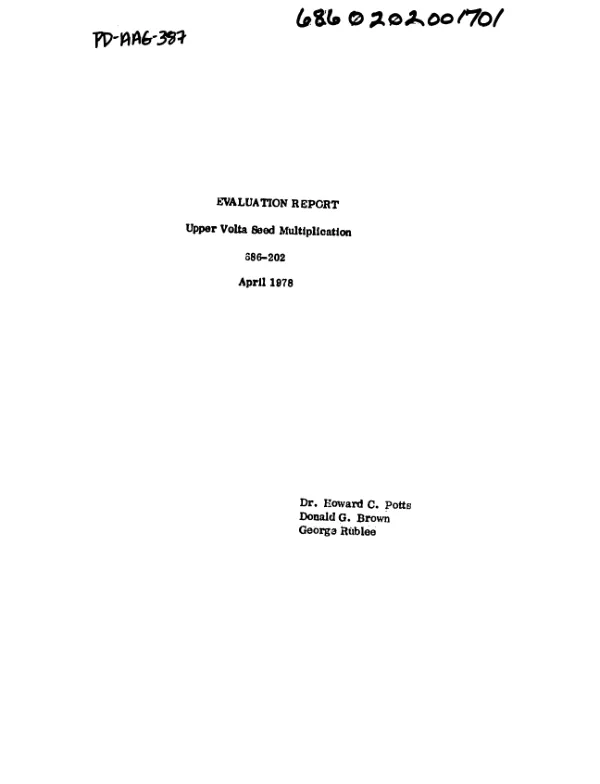
UPPER VOLTA SEED MULTIPLICATION
Evaluates project to establish a National Seed Service (NSS) to produce improved seed varieties in Upper Volta.
POTTS, HOWARD G.|BROWN, DONALD G.|RUBLEE, GEORGE · 1978
Sign in to readA free account is required to download.
Abstract
This special evaluation covers the period 1/1/74-4/30/78 and is based on interviews with project personnel and beneficiaries. Project staffing has been insufficient -- a demonstration program for farmers has not been initiated because the technician has not yet arrived. NSS, also in critical need of key personnel, has released improved varieties of corn, rice, peanuts, sesame, and soybean to the farmers but has not developed improved millet or sorghum seeds. Despite the lack of long-term assistance, seed research programs have been established and training has been provided to 10 of 24 planned extension agents and to 11 (against 4 planned) local seed multiplication officers. NSS efforts to determine the effective demand for seed and to allocate the seed produced have been sabotaged by the government's seed pricing policy, the major problem faced by the project. Because the price of seed is tied to the fixed price of food, official seed prices are artificially low--often less than 50% of the free market grain price for the same produce. It is close to impossible for seed research stations to recover seed products from farmers and, since much of the seed sold is being used for "cheap" food rather than planted, the true relationship of demand for seed and the amount produced cannot be determined. Seed can only be produced on a subsidy basis because production costs exceed the selling price. Efforts to encourage the government to change its pricing policy are therefore essential to prevent the project from being derailed. A.I.D. should also support NSS efforts to improve its reporting system, expand the use of its laboratory, and expand its field survey and collection activities. A minimum of 5 years of additional inputs (especially personnel) are needed to make NSS self-sufficient. Increased emphasis must be placed on training, on maintaining the purity of foundation seed, and on marketing the seed produced. Finally, the program should be supported by a strengthening of the rural development organizations.
Related documents