AMEX INTERNATIONAL, INC.
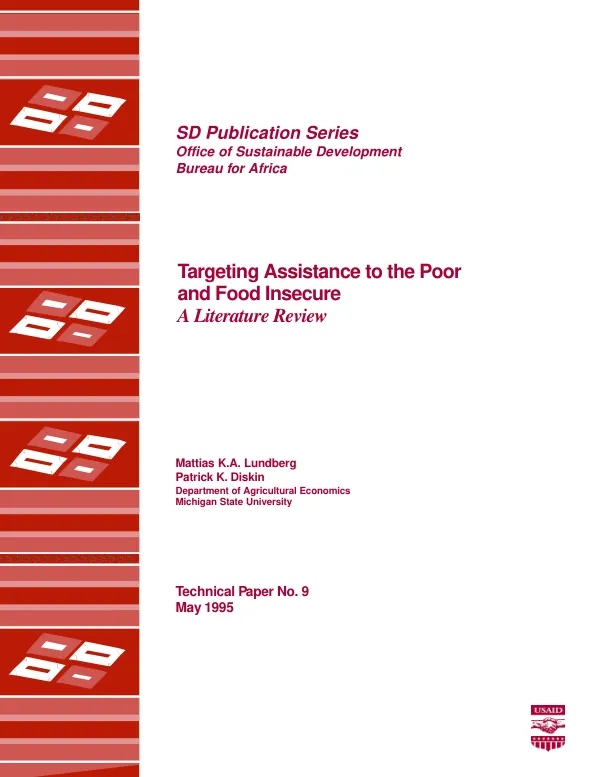
Targeting assistance to the poor and food insecure : a literature review
A challenge in delivering food assistance is to ensure through targeting that assistance gets to the neediest people and does not "leak out" to segments of the population who do not really need it.
Lundberg, Mattias K. A.; Diskin, Patrick K. · 1995
Sign in to readA free account is required to download.
Abstract
This comprehensive literature review and summary of targeting programs that deliver food assistance to poor and food insecure populations, defines and offers the rationale for targeting, reviews criteria for evaluating targeting mechanisms (selection accuracy, relevance and timeliness, incentive effects, political costs, and administrative costs), and then reviews two types of targeting mechanisms: (1) administered targeting methods, including a method that relies on multiple-household level indicators, one that relies on household level indicators, and one that relies on intra-household level indicators; and (2) self-targeting methods, including targeting by consumer preferences, by distribution methods, by public works, and by other methods, such as through social stigma and intimidation. The report concludes that the best long-range strategy for achieving food security is to increase incomes of vulnerable households and individuals. However, until food security is achieved, targeting is necessary. Recommendations are provided for criteria that any targeting mechanism must satisfy. Includes references.
Connected topics
Related documents