USAID DEC
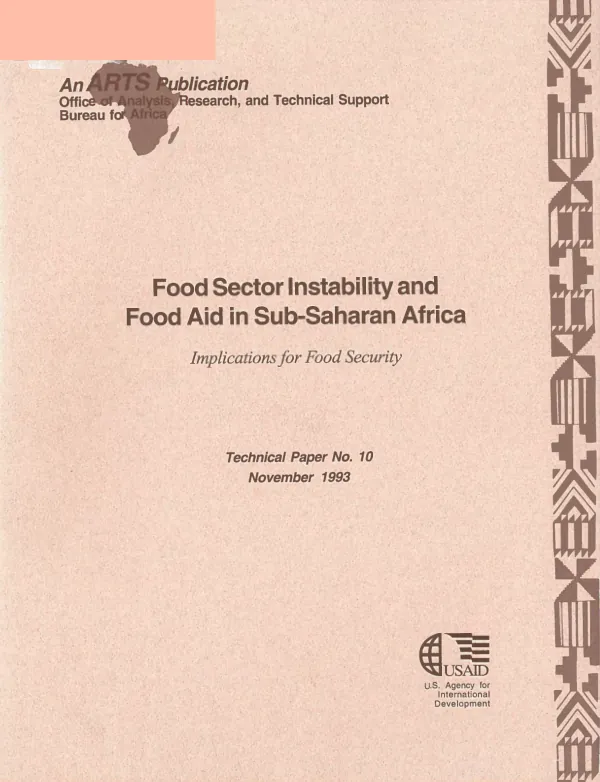
Food sector instability and food aid in sub-Saharan Africa : implications for food security
Sign inUSAID. BUR. FOR AFRICA. OFC. OF ANALYSIS, RESEARCH AND TECHNICAL SUPPORT
Food sector instability and food aid in sub-Saharan Africa : implications for food security
Up to a third of Africa"s population may suffer transitory food insecurity due to the wide fluctuation in food production and prices, both seasonally and between years, prevalent in much of the continent.
Kangasniemi, Jaakko; Staatz, John M. · 1993
Sign in to readA free account is required to download.
Abstract
This paper examines the relation between food sector instability and food insecurity and outlines ways in which food aid can be used to alleviate the situation. Chapter 2 examines how food price instability disproportionately affects the poor, while Chapter 3 examines aspects of food sector instability, emphasizing the effects of poor market integration across location (in-country or abroad), time, and products; the role of nonfarm income in helping people to cope with instability is also assessed. Chapter 4 discusses indicators to measure food sector instability, as well as to guide the use and evaluate the effectiveness of food aid. Chapter 5 then examines at length how food aid can be used to mitigate transitory food insecurity, e.g., by supporting price stabilization, providing food transfers to those most in need, supporting stabilizing investments in agricultural research or rural infrastructure, providing public works employment, and supporting policy reform. Conclusions are offered in Chapter 6: (1) The use of food aid to support policy changes and public goods is more cost-effective in the long run than is direct food aid. Donors should use political leverage to promote policy reforms that reduce food sector instability. (2) Price stabilization goals should not be too ambitious: extremely high prices are worth preventing, but some seasonal price fluctuation is reasonable. (3) By careful advance planning, emergency food aid can be expeditiously incorporated into public works programs. (4) The main road to food security is poverty alleviation, which requires broad-based rural development. Includes references.
Related documents