MERCY CORPS INTERNATIONAL
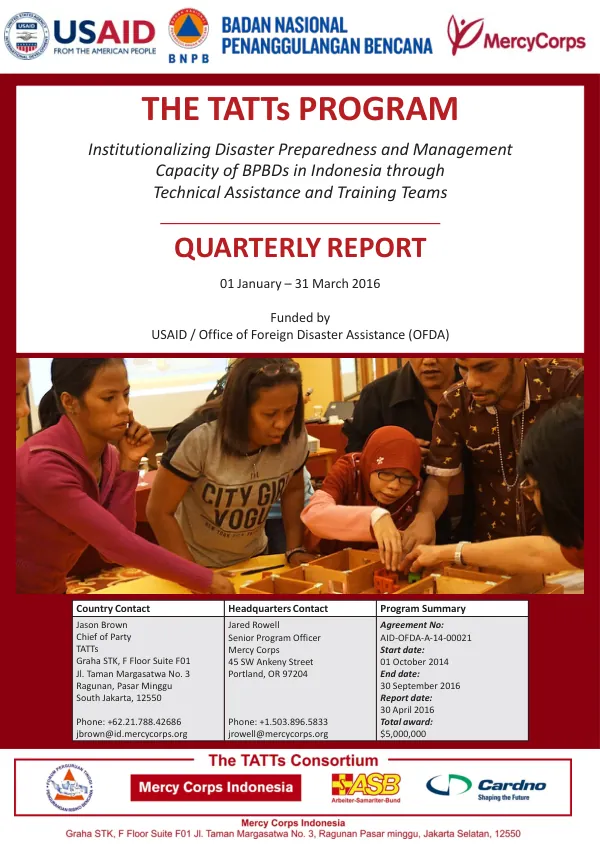
TATTs Quarterly Report: Jan-Mar 2016
Institutionalizing Disaster Preparedness and Management Capacity of BPBDs in Indonesia through Technical Assistance and Training Teams (TATTs) continued to focus on a broad range of technical training and institutional support initiatives during Quarter 6 (January to March 2016).
2016 · 12 pages
Sign in to readA free account is required to download.
Abstract
The program, funded by USAID/Office of Foreign Disaster Assistance (OFDA), aimed to enhance the capacity of BPBDs (Badan Penanggulangan Bencana Daerah) in Indonesia. During this quarter, TATTs teams in the provinces conducted 20 trainings, including 11 disaster simulation drills and exercises, involving 983 participants (67% male and 33% female). Additionally, 40 in-house training, mentoring, and support activities were held across the TATTs provinces, involving 599 participants (71% male and 29% female). The Lingkar Association began officially operating with the BNPB National Training and Education Unit, and Arbeiter-Samariter-Bund (ASB) hosted two national Disability Inclusive DRR workshops, bringing together 25 Disabled People's Organizations from 8 provinces and more than 50 government and non-government DRM stakeholders. Preparation activities were implemented for the new provinces of West Sumatra and East Java, which will be added to the expanded TATTs program following finalization of the Cost Modification with USAID/OFDA. The Chief of Party and National Training Coordinator visited the proposed new BPBDs, meeting with agency leadership to socialize the TATTs program and seek local government support for disaster management capacity building. The level of support and enthusiasm for the program was high. Key themes emerging during Quarter 6 included Inclusive DRR, Disaster Management Logistics, and Contingency Planning. Consortium partner ASB led two separate week-long workshops for Disabled People's Organizations (DPOs) and disaster management government and non-government stakeholders to build improved understanding of disability and DRR issues and create stronger provincial networks and local inclusion strategies. TATTs has been working with World Food Programme and local BPBDs on building local logistics capacity, and the Central Java team supported the provincial BPBD to conduct contingency planning for flood in the Jepara District. Staff reshuffle in Papua and temporary re-assignment of the head of West Papua BPBD resulted in lack of leadership and decision-making impacting on local Disaster Management (DM) programs throughout Quarter 6. Ongoing issues regarding agreements between the Government of Indonesia and USAID created difficulties in creating operating space, particularly at the national level. The TATTs program continued to implement a range of activities, including biannual TATTs meetings, mentoring sessions, self-assessments, and joint work plans with BPBDs for Year 2. Initial stakeholder mapping started in Quarter 6 for West Sumatra and East Java, and development of plans, strategies, and policies was ongoing. Prioritization of disaster simulations was identified in joint work plans, and simulations were implemented in Southeast Sulawesi, Central Java, and Papua. Consortium partner ASB completed a range of important social inclusion activities to support the TATTs program, including participation in the TATTs Harmonization Workshop and the establishment of the Lingkar Association. The program also introduced social media tools for improved communication and knowledge exchange in North Maluku. The TATTs program continued to make progress in Quarter 6, with a focus on technical training and institutional support initiatives. However, challenges such as staff reshuffle and temporary re-assignment of the head of West Papua BPBD impacted on local Disaster Management (DM) programs. Ongoing issues regarding agreements between the Government of Indonesia and USAID created difficulties in creating operating space, particularly at the national level.