USAID DEC
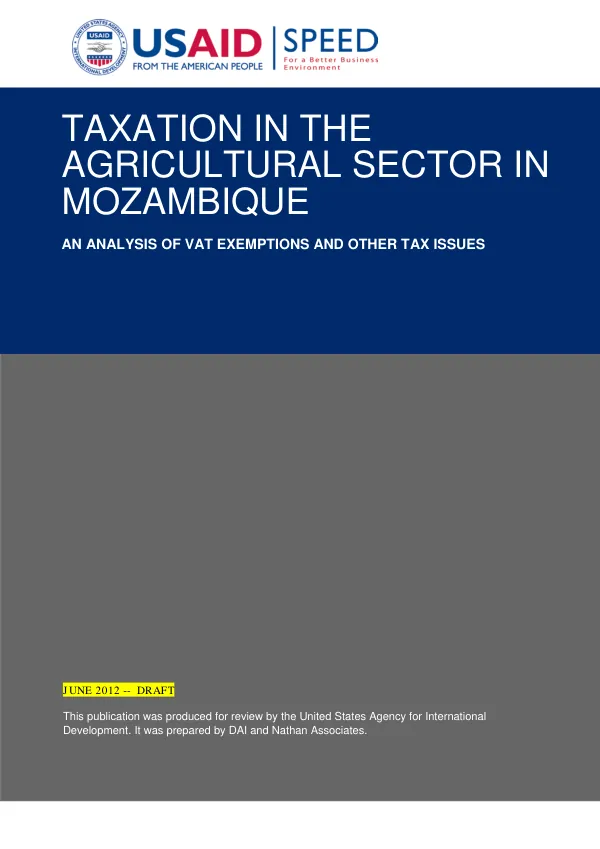
Taxation in the Agricultural Sector in Mozambique: An Analysis of VAT Exemptions and Other Tax Issues
Sign inDAI
Taxation in the Agricultural Sector in Mozambique: An Analysis of VAT Exemptions and Other Tax Issues
The agricultural sector in Mozambique is subject to various tax exemptions and zero-rating policies, which can have significant impacts on agricultural production and small-scale farming.
2012 · 43 pages
Sign in to readA free account is required to download.
Abstract
The Value-Added Tax (VAT) is a key tax in Mozambique, with a standard rate of 17%. However, certain agricultural products and services are exempt from VAT or subject to zero-rating. The VAT system in Mozambique is designed to tax the value added at each stage of production and distribution. The tax is levied on the difference between the value of goods or services sold and the value of goods or services used in their production. The VAT rate is applied to the value added at each stage, with the final consumer bearing the tax burden. Agricultural products and services that are exempt from VAT in Mozambique include raw peanuts, processed peanuts, and other agricultural products. However, some agricultural products, such as peanut products, are subject to zero-rating, which means that they are taxed at a reduced rate or not at all. The zero-rating of peanut products is intended to encourage their production and export. The "taxa liberatoria" is a 20% income withholding tax on unregistered taxpayers, which can have a significant impact on small-scale farming. The tax is levied on the income of unregistered taxpayers, including small-scale farmers, and is intended to encourage them to register for tax purposes. The Mozambique Revenue Authority is responsible for administering the VAT system and ensuring compliance with tax laws and regulations. The authority has implemented various measures to improve tax compliance, including the use of electronic tax returns and the establishment of a tax ombudsman. The agricultural sector in Mozambique is a significant contributor to the country's economy, with agriculture accounting for approximately 25% of GDP. The sector is dominated by small-scale farmers, who produce a wide range of crops, including maize, beans, and peanuts. The sector is also characterized by a high level of informality, with many farmers operating outside the formal tax system. The impact of tax policies on the agricultural sector in Mozambique is complex and multifaceted. While tax exemptions and zero-rating can provide incentives for agricultural production, they can also create distortions in the market and undermine the tax base. The "taxa liberatoria" can have a negative impact on small-scale farming, as it can create a disincentive for farmers to register for tax purposes. The Mozambique government has implemented various policies to support the agricultural sector, including the provision of credit and input subsidies to farmers. However, the sector continues to face significant challenges, including limited access to markets and inputs, as well as a lack of infrastructure and technology. The agricultural sector in Mozambique is also subject to regional and international trade agreements, which can have a significant impact on the sector's development. The Southern African Development Community (SADC) has implemented a common VAT rate of 14%, which is lower than the standard rate in Mozambique. However, the SADC VAT rate is not applicable to all agricultural products, and the sector continues to face significant trade barriers. The Mozambique government has implemented various measures to improve the business environment and attract investment to the agricultural sector. However, the sector continues to face significant challenges, including limited access to finance and markets, as well as a lack of infrastructure and technology.