FOOD AND AGRICULTURE ORGANIZATION OF THE UNITED NATIONS IN GEORGIA
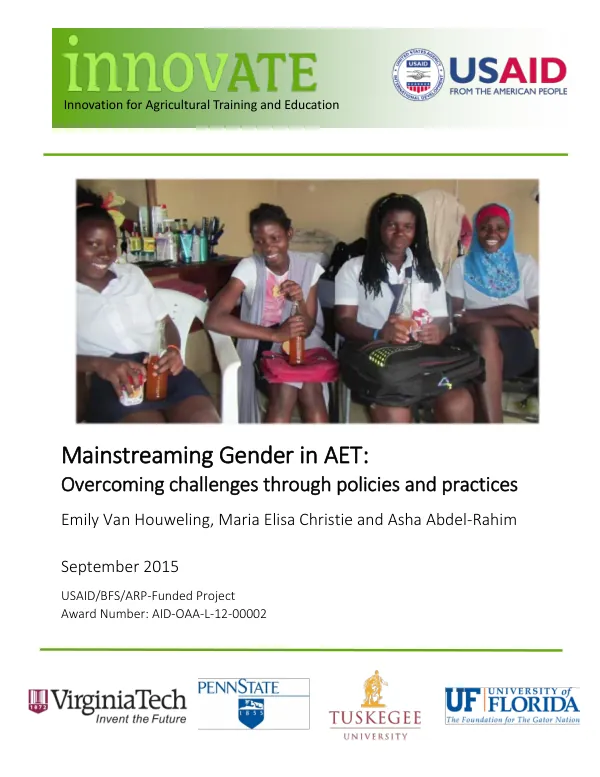
Innovation for Agricultural Training and Education: Mainstreaming Gender in AET
Women's education has a high positive impact on society, and higher education can empower women to enter social, economic, and political roles in their communities and countries.
2015 · 47 pages
Sign in to readA free account is required to download.
Abstract
While progress has been made in terms of access to education overall and higher education in particular, women continue to face specific challenges that limit their access to and success in higher education. Case studies from around the world reveal multiple gender issues that keep women out of higher education institutions and prevent them from graduating. Women farmers play a vital role in agriculture around the world, yet their roles are often invisible, and the contribution of women farmers to agriculture is overlooked in higher education agricultural curricula in most countries. Similarly, women students are underrepresented in higher education agricultural programs in most countries. Increasing the number of women in university agricultural programs as students, faculty, and high-level administrators will improve the representation of women in important policy debates and decision-making processes in agriculture. Providing women with opportunities for training and education in agriculture will ensure that women are helping to shape future agricultural innovation approaches and technologies. A wide range of literature exists about gender issues in education from primary through tertiary, and there is a growing body of research on the specific challenges that girls and women face within higher education institutions in developing countries. However, less is known about the challenges and opportunities women and girls have specifically with university agricultural programs. The few studies conducted in this area found that cultural, economic, institutional, political, and social issues constrain women's participation in agricultural education and training. A review of gender issues in agricultural education and extension conducted by the Food and Agriculture Organization of the United Nations identified the following as some of the main explanations of women's low participation: women's lack of time due to household responsibilities, cultural norms that value education for boys over girls, and cycles of poverty in which families keep their daughters home to work or marry them early. Effective interventions that address gender disparities must target these multifaceted dimensions of society. This requires moving beyond parity, or merely numerical balance among men and women students and professionals, to a more complex concept of equality in which young men and women have equal access to quality schooling and opportunities, feel safe and supported in the school environment, and the curricula and approaches to teaching are not gender-biased. This paper offers recommendations and good practices for accomplishing these goals within higher education agricultural programs. The paper proceeds by discussing the general constraints that girls and women face in higher education and the specific challenges identified in higher education agricultural programs. The characteristics of successful young women students in agricultural education and training are also described. Recommendations and good practices for addressing gender issues are provided, and the paper concludes with a summary of the key findings and implications for policy and practice. The research for this paper was conducted through a literature review, a regional conference workshop in Mozambique, and interviews and focus groups conducted in four countries: South Sudan, Mozambique, Bangladesh, and Cambodia. These countries were selected because they were sites where the Virginia Tech-led InnovATE program had activities or where researchers had access to the universities through other projects. This group of four countries also represents regions where there are the greatest gender disparities in higher education. Interviews and focus groups were conducted with men and women students, faculty, and administrators in these countries to gather data on the challenges and opportunities women and girls face in higher education agricultural programs. The literature review and data collected from the interviews and focus groups reveal that women face a range of challenges in higher education agricultural programs, including cultural, economic, institutional, political, and social issues. These challenges impact women's access to education overall and channel fewer girls into higher education institutions. Important gender issues specific to higher education discussed in this paper relate to the curriculum, the institutional climate, safety concerns, and access barriers. Effective interventions that address gender disparities must target these multifaceted dimensions of society, moving beyond parity to a more complex concept of equality in which young men and women have equal access to quality schooling and opportunities. Recommendations and good practices for addressing gender issues in higher education agricultural programs include increasing the number of women in university agricultural programs as students, faculty, and high-level administrators, introducing gender sensitization at all levels, addressing safety issues for women students, creating a supportive environment for women students, and improving perceptions and visibility of agricultural education and careers. These recommendations are based on the literature review and data collected from the interviews and focus groups, and they aim to address the specific challenges women face in higher education agricultural programs.
Related documents