KNCV TUBERCULOSIS FOUNDATION
TB CARE Annual Work Plan and Budget
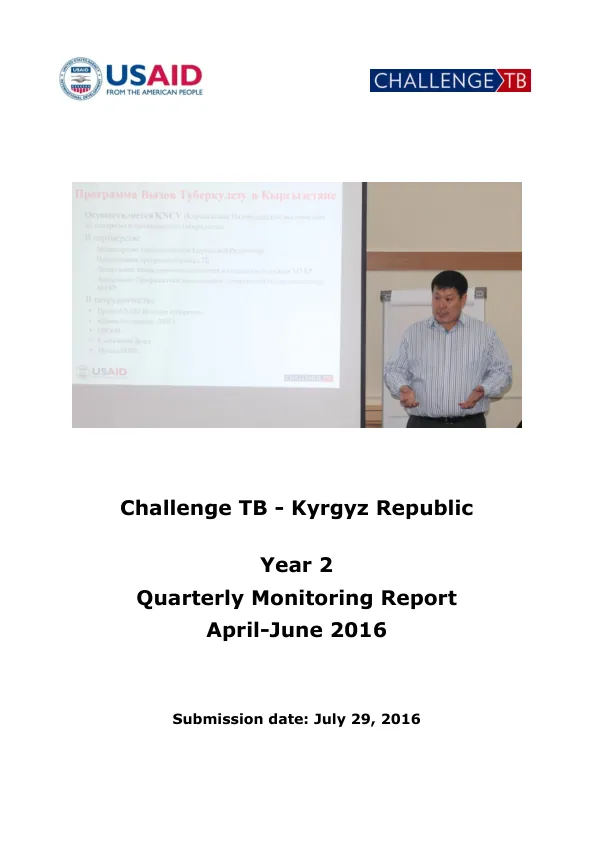
The Challenge TB project in the Kyrgyz Republic is a collaborative effort between the KNCV Tuberculosis Foundation (KNCV) and other partners to combat tuberculosis (TB) in the country.
2016 · 17 pages
Sign in to readA free account is required to download.
Abstract
The project's lead partner is KNCV, and it operates under the guidance of the National Tuberculosis Program (NTP) and the Ministry of Health (MoH). The project's work plan spans from October 2015 to September 2016, with the reporting period covering April to June 2016. During this quarter, the project facilitated a partners' meeting on May 30, 2016, which brought together national and international partners to discuss the implementation of new TB drugs and short regimens. The meeting helped to move forward the preparation for the introduction of these new treatments, and partners agreed to work together to address the necessary steps. However, the lack of accreditation of TB facilities to provide diagnosis and treatment, as well as the halt of clinical trials for the FC-1 pharmaceutical product, posed significant challenges to the project's progress. The project also made significant progress in developing operational research protocols for the introduction of shortened MDR-TB treatment regimens and regimens containing new drugs. The protocol was updated in accordance with the last WHO updates announced in May 2016 and will be translated into Russian, agreed upon by the ethics committee, and approved by the MoH in August-September 2016. In addition, the project made progress in developing a system for linking laboratory, clinicians, register, and SES in pilot sites. Draft SOPs for the link between laboratory, clinicians, and SES were developed, and the draft will be discussed with clinicians, laboratory, and SES specialists in the training in July and will be updated in accordance with the feedback of participants. The project also supported the development of a database for patient registration and monitoring in CTB pilot sites, which was met. Furthermore, the project made progress in developing a system for clinical monitoring and active pharmacovigilance, including guidelines for adverse effect management and SOPs for adverse drug reaction monitoring. The project also conducted coordination partners' meetings, which were met. Additionally, the project provided trainings for clinical, laboratory, PV, and SES personnel in pilot sites, which were conducted. The project also supported patient selection, enrolment, and monitoring, which was conducted. The project also provided support to the Global Fund implementation in Year 2. The current Global Fund TB grants include the KGZ-S10-G08-T grant implemented by UNDP and the KGZ-910-G07-T grant implemented by HOPE. The in-country Global Fund status indicates that the grant implemented by UNDP is being implemented on a sufficient level, and UNDP is working with MoH and NTP on a transition plan to grow the capacity of local specialists for the transition of responsibilities on implementation grant to the MoH. Despite the general implementation of the GF grant, the country has experienced delays in the delivery of Bedaquiline and companion drugs, which were postponed from June 2016 to November 2016. This delay is related to difficulties in calculating the number of DR TB patients and limitations of M&E teams of NTP and UNDP in data analysis and coming to consensus on final data. To address this issue, NTP invited all related parties to discuss and resolve the problem.