KNCV
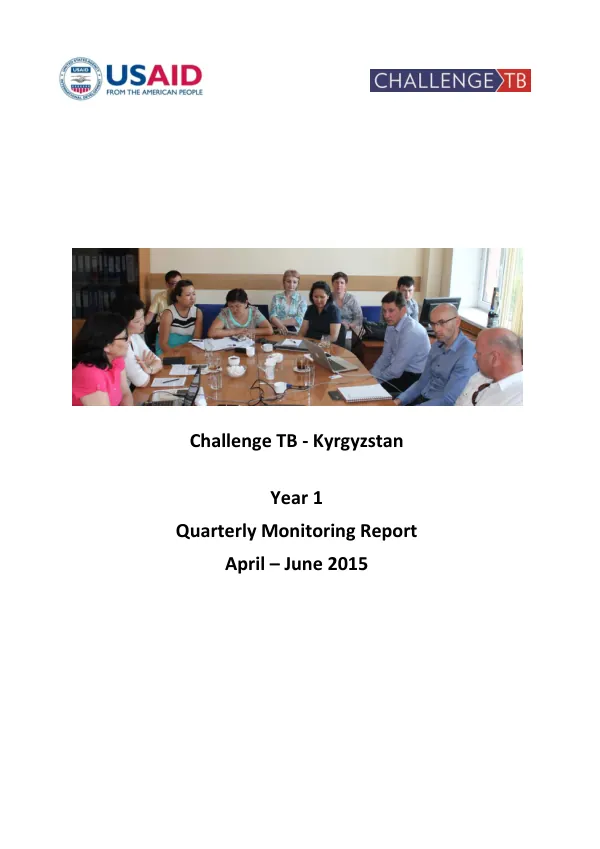
Quarterly Monitoring Report: Challenge TB - Kyrgyzstan, Year 1, April – June 2015
The Challenge TB project in Kyrgyzstan was launched in June 2015, with funding from the Global Fund.
2015 · 10 pages
Sign in to readA free account is required to download.
Abstract
The project's lead partner is KNCV, and other partners include USAID, UNDP, WHO, MSF, and HIV center. The project's workplan timeframe is October 2014 to September 2015, and the reporting period is April to June 2015. The most significant achievements during this quarter include the approval of the Challenge TB strategy, work plan, and budget for year 1 in April 2015. The project was officially launched on June 25, 2015, during a partners meeting. KNCV conducted an M/XDR-TB situation analysis and assessment of clinical pathways and access to DR-TB diagnosis and treatment for adults and children. The results were presented and discussed at a partners' meeting, and a plan for the introduction of new drugs and regimens was prepared based on the analysis. Country Director Bakyt Myrzaliev participated in the international GDI/GLI meeting in April, where advancements and opportunities in diagnosis and treatment with country experiences in strengthening and aligning diagnosis and treatment of DR TB cases were presented. Recommendations on including comparison use of Bedaquiline and Delamanid in the Law of the Kyrgyz Republic on drugs were provided to the Ministry of Health. The USAID TB CARE I funded CORE project on "Local ownership" was completed in June 2015, and the KNCV Benchmarking Tool for Childhood TB Policies and Practice was discussed and filled with leading pediatric TB experts of Kyrgyzstan. Technical and administrative challenges faced during this quarter include resistance from the Ministry of Health due to regulatory requirements in relation to the use of new medicines. Intensive negotiations were conducted with the Ministry of Health, and by the end of July 2015, approval for the supply of Bedaquiline and Delamanid for one year is expected. Additionally, limited budget and HR resources in the Challenge TB country team were identified, and it was decided to discuss the possibility of hiring one or part-time staff with the USAID mission. The project's activity progress is reported under sub-objective 3, Patient-centered care and treatment. The planned key activities for the current year include situational assessments of MDR-TB patients who interrupted or failed treatment in the past, assessment of the M/XDR-TB situation, and development of a protocol for analysis and tool for data collection. The assessment of the M/XDR-TB situation was partially met due to unexpected big workload at the NTP level, and the patients review protocol was postponed. The national XDR-TB management guidelines were finalized during the partners meeting, and recommendations for changes in drug law were provided to the Ministry of Health. Challenge TB's support to Global Fund implementation in year 1 includes providing support to the NTP in updating and finalizing the Concept Note for resubmission in August. The Fund Portfolio Manager visited Kyrgyzstan in June, and Challenge TB team had a meeting with him to introduce the project goals and activities in Kyrgyzstan. GF/UNDP fully supports the plan of introduction of shorter regimens and effective regimens for XDR patients, and it was agreed that for the next year, the country will include 100 DR-TB patients for short regimens under OR conditions and 20 patients for the new drugs treatment. GF and UNDP agreed to procure necessary drugs for short regimens and XDR cases. The current Global Fund TB grants in Kyrgyzstan include KGZ-S10-G08-T, UNDP, and KGZ-910-G07-T, HOPE. The in-country Global Fund status includes submitting the Concept Note for review in April 2015 and getting it back with questions for updating and clarifications in May 2015. The membership of the Country Coordinating Mechanism (CCM) was updated, and the transition of the Principal Recipient (PR) from UNDP to MoH was postponed for one year. Challenge TB provided support to the NTP in updating and finalizing the Concept Note for resubmission in August, and GF/UNDP fully supports the plan of introduction of shorter regimens and effective regimens for XDR patients.
Related documents