INTERNATIONAL ORGANIZATION FOR MIGRATION
TB CARE Annual Work Plan and Budget
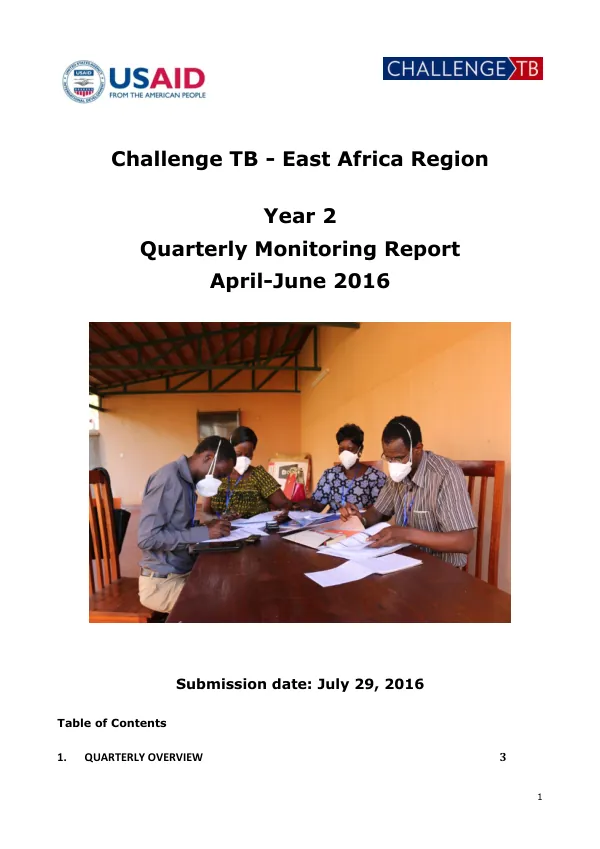
The Challenge TB East Africa Region Year 2 Quarterly Monitoring Report for April-June 2016 highlights significant achievements and progress in implementing the project's activities.
2016 · 16 pages
Sign in to readA free account is required to download.
Abstract
The report covers the East Africa Region, with Kenya as the lead country, and involves other partners such as MSH and The Union. During this quarter, the project team was fully operational, enabling the acceleration of project kick-off activities. These included a sensitization workshop for border health facility staff on the cross-border TB initiative in three counties, a regional National TB Program meeting, and the printing of TB Infection Control Standard Operating Procedures (TB IC SOPs). The project coordinator and M&E officer attended the Country Directors' Meeting in The Hague, where they shared best practices and experiences in implementing CTB activities among CTB countries. They also linked up with CTB country projects in the East Africa and Horn of Africa region, laying a strong foundation for close collaboration. The project coordinator and M&E officer also attended a five-day training on programmatic management of drug-resistant TB (PMDT) in Rwanda, hosted by the Centre of Excellence (COE) on PMDT at the School of Public Health of the University of Rwanda. The training facilitators were from the Ministry of Health, WHO, and NTP, and the participants gained important knowledge on PMDT, including case detection, case retention, and TB infection control. The cross-border initiative made significant progress, with 59 health workers from 30 border health facilities and refugee camps in three counties sensitized on the cross-border TB initiative. The teams developed county-specific action plans identifying TB-related issues that need to be addressed in-country and those by the country on the other side of the border. A two-day East Africa and Horn of Africa Regional NTP Meeting was held in April 2016, attended by NTP managers and M&E focal persons from Kenya, Uganda, Somaliland, Somalia, and South Sudan. The meeting introduced NTPs to the Challenge TB East Africa regional project, KNCV strategic approaches, and progress made. Bio-safety measures in laboratories were ensured through the translation of SOPs on TB-Infection Control in the Somali language, which was finalized based on comments made by Somali laboratory teams. 500 copies were printed, and dissemination of these SOPs is planned for the next quarter. Qualified staff were available, and supportive supervisory systems were in place. An inventory of existing and potential training institutions for the training corridor in the region was developed by the EA region team. The Rwanda-based Center of Excellence (COE) conducted its 7th international training on PMDT in May 2016, with 20 participants from six countries attending. KNCV selected and contracted a consultancy firm to develop a business plan for COE in line with its objectives to become a regional center of excellence. The business plan will be ready during the next quarter, and a dissemination workshop is proposed. Administrative challenges, such as delays in the first quarter, will be avoided by better planning and taking into consideration possible delays. The team registered with ECHO to travel to Moyale in Marsabit county in a cost-effective manner. Insecurity due to banditry or terrorist acts remains a major challenge for the implementation of CTB project activities, especially in the Kenya-Somalia border. The project is developing a security plan to support decision-making around implementation, monitoring, and supervision of project activities in the mentioned area. The project's progress in implementing an effective patient referral system, improving TB case detection and treatment, and enhancing bio-safety measures in laboratories is notable. The project's efforts to develop a business plan for COE and establish a regional training corridor for TB are also significant.