PACT
TEACH II Project Completion Report
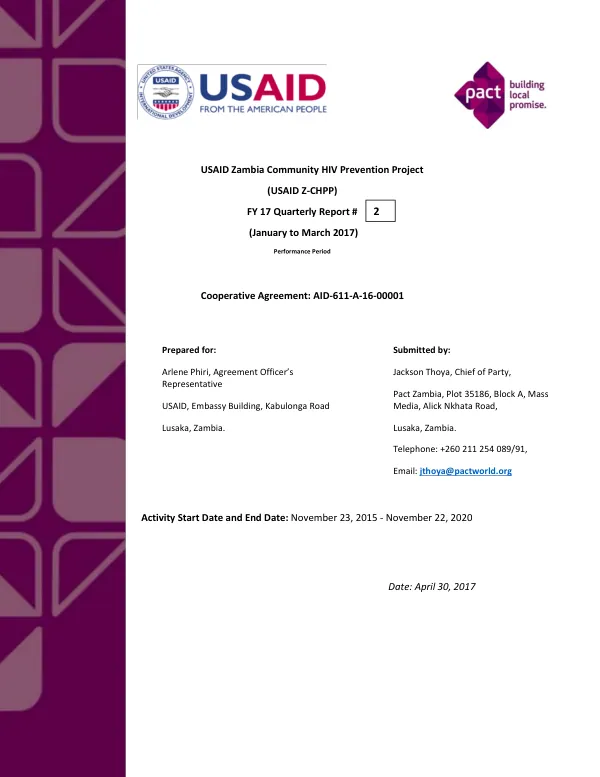
The Zambia Community HIV Prevention Project (Z-CHPP) is a five-year initiative implemented by Pact in partnership with the Government of the Republic of Zambia and other stakeholders.
39 pages
Sign in to readA free account is required to download.
Abstract
The project aims to reduce the spread of HIV among high-risk populations, including adolescent girls and young women, and to improve access to HIV testing and treatment services. The project is funded by the United States Agency for International Development (USAID) under the President's Emergency Plan for AIDS Relief (PEPFAR). The project's major accomplishments during the first quarter of FY 2017 include enhancing and scaling up community-led outreach, social and behavior change communication (SBCC), and the development of tailored SBCC materials. The project also established community HIV prevention manuals and conducted stakeholder entry meetings and monthly district stakeholder coordination meetings. Additionally, the project promoted effective communication within couples and children, and scaled up HIV testing services (HTS) in target areas. The project's DREAMS (Determined, Resilient, Empowered, AIDS-free, Mentored and Safe) component focused on coordinating DREAMS activities, setting up safe spaces and DREAMS centers, screening and enrolling participants into safe space sessions, and providing technical support. The project also conducted economic strengthening activities, including reviewing and adapting training manuals, training master trainers on own savings for assets and wealth creation (OSAWE) and enterprise your life (EYL), and providing capacity development support to project staff and partners. The project's monitoring, evaluation, and research activities included strengthening the monitoring and evaluation system, conducting data quality assurance, and developing a DREAMS database. The project also managed sub-awards, oriented new sub-partners, and conducted desk reviews and monitoring visits. Additionally, the project updated its human resources, collaborated with stakeholders, and identified challenges faced during the quarter. The project's planned activities for the next quarter include continuing community HIV prevention activities, scaling up DREAMS activities, and implementing economic strengthening activities. The project will also continue to develop the capacity of its staff and partners, and will conduct monitoring, evaluation, and research activities to assess the project's impact and inform future programming. The project's success stories are highlighted in Annex 1, and the indicator summary table is presented in Annex 2. The project's objectives and indicators are outlined in the Objectives/Indicators section. The project's geographic focus is on the Republic of Zambia, with a specific emphasis on high-risk populations, including adolescent girls and young women. The project's timeframes are from November 23, 2015, to November 22, 2020, with quarterly reports submitted to USAID. The project's implementation is guided by a range of stakeholders, including the Government of the Republic of Zambia, civil society organizations, and community-based organizations. The project's technical assistance is provided by Pact, with support from USAID and other partners. The project's economic strengthening activities aim to improve the economic well-being of high-risk populations, including adolescent girls and young women. The project's DREAMS component focuses on empowering adolescent girls and young women to make informed decisions about their health and well-being. The project's monitoring, evaluation, and research activities aim to assess the project's impact and inform future programming. The project's human resources are updated regularly to ensure that the project has the necessary capacity to implement its activities. The project's stakeholder collaboration is critical to its success, and the project works closely with a range of stakeholders, including the Government of the Republic of Zambia, civil society organizations, and community-based organizations. The project's challenges are identified and addressed through regular monitoring and evaluation activities.
Related documents