USAID DEC
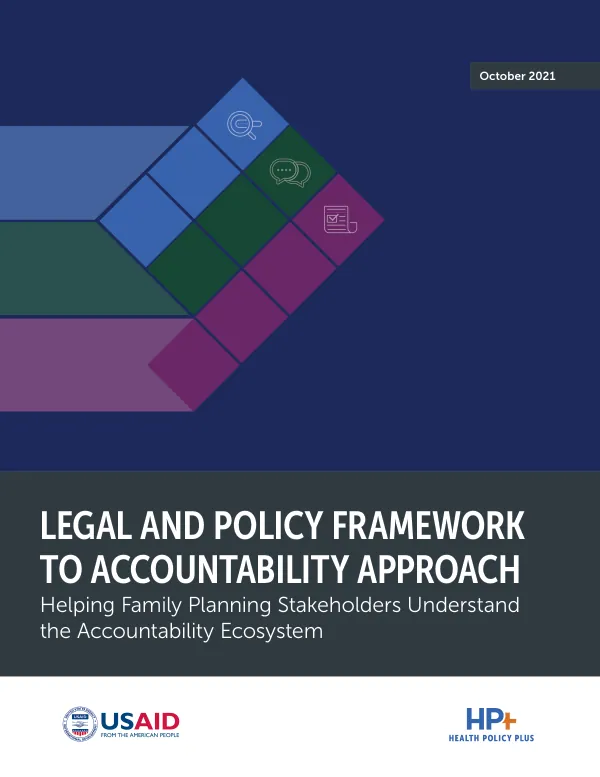
Legal and Policy Framework to Accountability Approach: Helping Family Planning Stakeholders Understand the Accountability Ecosystem
Sign inAVENIR HEALTH
Legal and Policy Framework to Accountability Approach: Helping Family Planning Stakeholders Understand the Accountability Ecosystem
Accountability in health is increasingly recognized as a key priority at the highest levels of the global health community.
2021 · 54 pages
Sign in to readA free account is required to download.
Abstract
For example, UNICEF's Global Strategy for Women's, Children's and Adolescents' Health (2016-2030) recognizes accountability as a key action area that harmonizes monitoring and reporting and promotes independent review and multi-stakeholder engagement leading to improved health outcomes. Further, accountability supports a rights-based approach to family planning by ensuring that access and provision of family planning services are relevant, high-quality, and responsive to client needs, as articulated in the United Nations' General comment No. 22 (2016) on the right to sexual and reproductive health (article 12 of the International Covenant on Economic, Social and Cultural Rights) and the World Health Organization's 2014 guidance on Ensuring Human Rights in the Provision of Contraceptive Information and Services. The accountability ecosystem for family planning is broadly defined to include a range of issues that affect the availability of family planning methods, including laws that relate to human rights and the right to health; policies that establish and protect cadres of health workers and define what their scopes of work include; laws that articulate different aspects of public accountability, such as citizen engagement in budgeting and planning; and laws that regulate speech, information dissemination, and the existence and roles of civil society. The ecosystem is based on the set of laws, policies, and regulations in their entirety that influence and shape the many aspects of family planning programming. Three types of accountability—political, financial, and programmatic—and multiple actors from a range of stakeholders—the government, clients/citizens, and providers—affect the achievement of family planning goals, making accountability for family planning complex and dependent on functioning relationships between those stakeholders. The Legal and Policy Framework to Accountability approach is designed to catalyze country-led action to improve accountability for family planning by improving family planning stakeholders' understanding of how different types of accountability are grounded within a variety of legal and policy frameworks. The approach is based on a comprehensive understanding of the accountability ecosystem for family planning, which includes laws, policies, and regulations that influence and shape the many aspects of family planning programming. By understanding the accountability ecosystem, stakeholders can design more strategic advocacy campaigns, establish connections with new partners, and address underlying systemic challenges to achieving family planning objectives in strategies and policies. The approach is intended to help stakeholders understand the accountability ecosystem, the opportunities it affords, and the gaps that limit it to improve the effectiveness of family planning strategies, policies, programs, and advocacy. The approach consists of three phases: desk review, consultations, and recommendations. The desk review phase involves a comprehensive review of existing laws, policies, and regulations that affect family planning programming. The consultations phase involves stakeholder engagement and feedback to identify gaps and opportunities in the accountability ecosystem. The recommendations phase involves the development of actionable recommendations to address the gaps and opportunities identified in the previous phases. The approach is designed to be flexible and adaptable to the specific needs and context of each country. The approach has been applied in Zambia, where it has been used to improve accountability for family planning by improving stakeholders' understanding of the accountability ecosystem. The approach has been found to be effective in identifying gaps and opportunities in the accountability ecosystem and developing actionable recommendations to address them. The approach has also been found to be effective in improving stakeholder engagement and feedback, which is critical to the success of family planning programming. Overall, the Legal and Policy Framework to Accountability approach is a comprehensive and flexible approach that can be used to improve accountability for family planning by improving stakeholders' understanding of the accountability ecosystem. The approach has been found to be effective in identifying gaps and opportunities in the accountability ecosystem and developing actionable recommendations to address them. The approach has also been found to be effective in improving stakeholder engagement and feedback, which is critical to the success of family planning programming.