FHI 360
Technical Intervention Note 3.1: Overview of Value Chain Approach
Value Chain (VC) Development is a process that encompasses entire market systems and affects multiple producers and businesses.
2015 · 2 pages
Sign in to readA free account is required to download.
Abstract
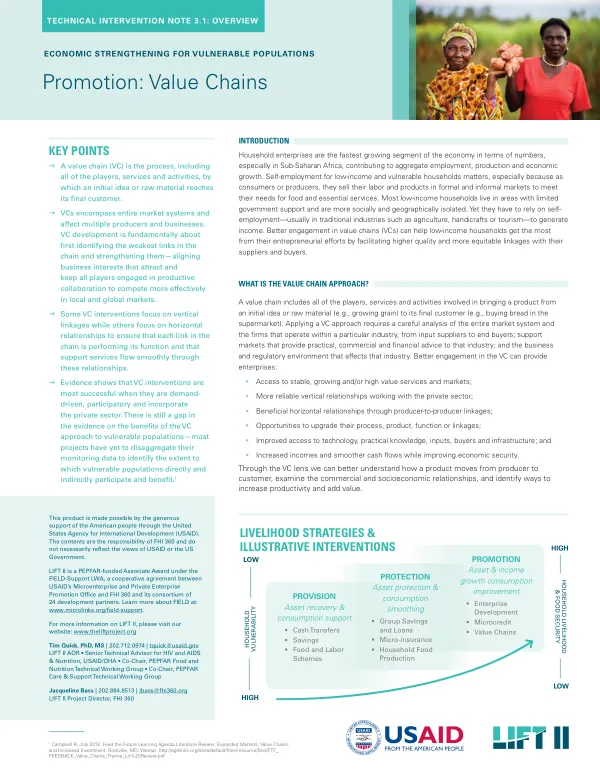
It involves identifying the weakest links in the chain and strengthening them by aligning business interests that attract and keep all players engaged in productive collaboration to compete more effectively in local and global markets. Household enterprises are the fastest growing segment of the economy in terms of numbers, especially in Sub-Saharan Africa, contributing to aggregate employment, production, and economic growth. Self-employment for low-income and vulnerable households matters, especially because as consumers or producers, they sell their labor and products in formal and informal markets to meet their needs for food and essential services. A value chain includes all of the players, services, and activities involved in bringing a product from an initial idea or raw material to its final customer. Applying a VC approach requires a careful analysis of the entire market system and the firms that operate within a particular industry, from input suppliers to end buyers. Better engagement in the VC can provide enterprises with access to stable, growing, and/or high-value services and markets, more reliable vertical relationships working with the private sector, beneficial horizontal relationships through producer-to-producer linkages, opportunities to upgrade their process, product, function, or linkages, improved access to technology, practical knowledge, inputs, buyers, and infrastructure, and increased incomes and smoother cash flows while improving economic security. Successful VC programs strive to follow key principles, including being systemic, high-impact, demand-driven, strengthening enterprise capacity, tailored, and sustainable at multiple levels. These programs aim to tackle big and recurring obstacles, ensure that households earn significant income from stable, profitable, and growing enterprises, and build on and build up clients' existing expertise and assets. VC interventions are most successful when they are demand-driven, participatory, and incorporate the private sector. However, there is still a gap in the evidence on the benefits of the VC approach to vulnerable populations, with most projects yet to disaggregate their monitoring data to identify the extent to which vulnerable populations directly and indirectly participate and benefit. The main features of value chain programs include a market systems approach, relationships, incentives, trust, upgrading strategies, social impacts, and sustainability. These programs aim to integrate low-income entrepreneurs into VCs, strengthen both the breadth and depth of social relationships, and create self-sustaining systems that meet the business needs of all stakeholders and contribute to poverty reduction.
Related documents