USAID DEC
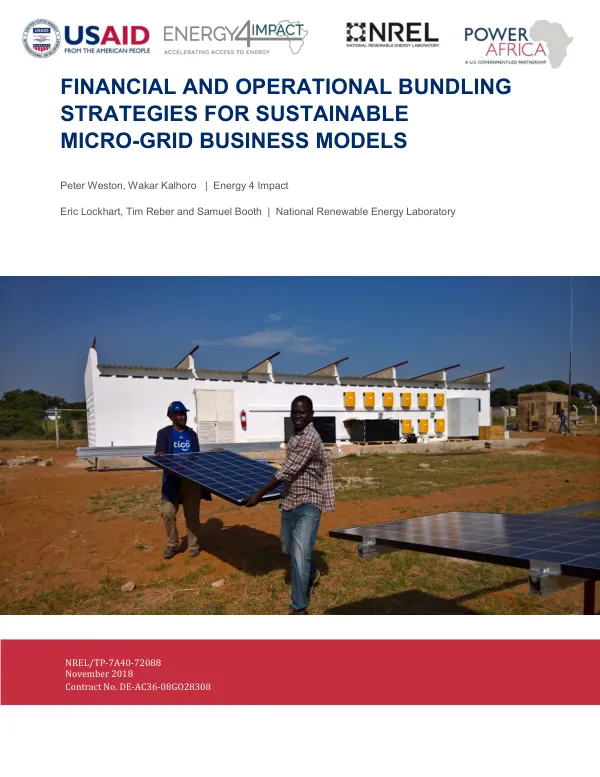
Financial and Operational Bundling Strategies for Sustainable Micro-Grid Business Models
Sign inDEPARTMENT OF ENERGY
Financial and Operational Bundling Strategies for Sustainable Micro-Grid Business Models
Micro-grid business models are critical for providing electricity access to the approximately 600 million people in Sub-Saharan Africa who currently lack electricity.
2018 · 39 pages
Sign in to readA free account is required to download.
Abstract
Private investment in the micro-grid sector is necessary for scaling, but it has been slow to take off due to high risk relative to reward, high transaction costs, policy and regulatory risk, and uncertainty about demand and customer willingness to pay. Bundling or aggregation of micro-grids is a potential solution to these challenges. At its simplest, bundling refers to combining projects or different aspects of projects into a portfolio to create efficiencies and economies of scale. There are two main types of bundling: operational bundling, which involves aggregating similar projects to reduce development and operating costs and spread risk, and financial bundling, which involves aggregating projects into a portfolio to attract more private investors through increased size and portfolio de-risking. Operational bundling can improve the viability of micro-grid developers and their projects by streamlining design and engineering, installation and commissioning, operations and maintenance, customer agreements, standardized productive use offerings, and performance monitoring and reporting. Financial bundling can be achieved through pooled funds for micro-grid operations and growth, pooled funds for electrical appliances, crowdfunding, and export credit finance. The Kalangala Infrastructure Services case study demonstrates a novel approach to micro-grid deployment and financing. The 1.6-MW micro-grid in Uganda was funded by debt and equity from development finance institutions as part of a larger transport-and water-infrastructure project. The Ruaha Energy case study also showcases a private developer that has used grants and U.S. private placements to fund village micro-grids and grid-tied renewable projects in Tanzania. The report provides a comprehensive overview of the financial and business model challenges related to Sub-Saharan African micro-grids and emerging solutions to consider applying or supporting. It is intended to be a resource for developers, donors, and governments, as well as investors, to understand the complexities of micro-grid business models and identify pathways to operational improvements that can lead to more attractive investments. Micro-grid business models can be categorized into several types, including government-driven models, developer-driven models, and donor-driven models. The mechanisms of project initiation, ownership and operation, and financial backing are also critical components of micro-grid business models. The report examines these components in detail, providing a comprehensive understanding of the complexities of micro-grid business models. The level of service and technologies deployed are also essential components of micro-grid business models. The report discusses the various methods of cost recovery, including prepaid meters, postpaid meters, and pay-as-you-go systems. It also examines the role of subsidies and grants, concessional loans, loan guarantees, and corporate or project finance in supporting micro-grid development.
Related documents