USAID DEC
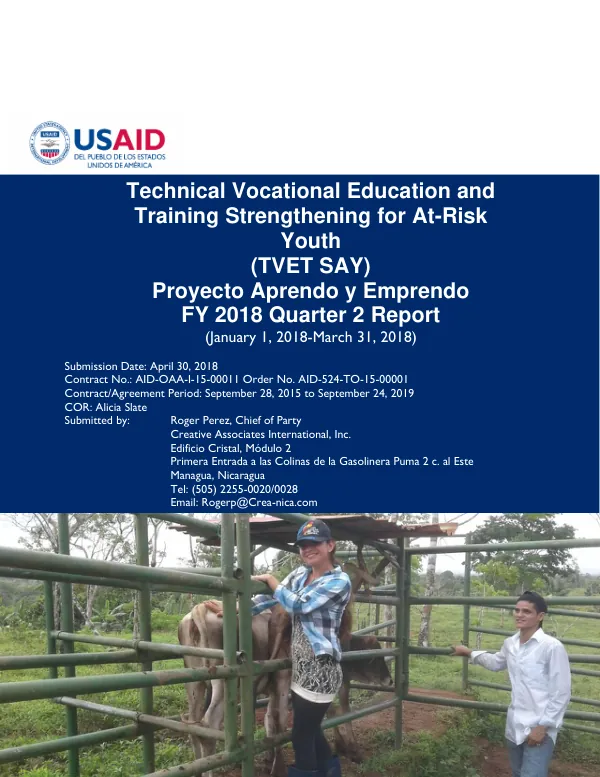
Technical Vocational Education and Training Strengthening for At-Risk Youth (TVET SAY) FY 2018 Quarter 2 Report
Sign inCREATIVE ASSOCIATES INTERNATIONAL INC.
Technical Vocational Education and Training Strengthening for At-Risk Youth (TVET SAY) FY 2018 Quarter 2 Report
The TVET SAY project is a four-year effort focused on strengthening institutions that offer technical and vocational education to benefit at-risk youth from the Caribbean Coast in Nicaragua.
2018 · 60 pages
Sign in to readA free account is required to download.
Abstract
The project goal is to improve security in the Caribbean Coast by providing youth with educational opportunities linked to jobs and livelihoods through strengthened educational centers that can educate youth in areas where there is a market demand. The TVET SAY project has four components with the following objectives: improve collaboration and information sharing among centers by establishing or strengthening a network of training centers, strengthen private TVET centers to be "model" institutions, increase interest and perceived value of TVET programs through public awareness campaigns, and increase socioeconomic gains for at-risk youth from the Caribbean Coast while enabling safer environments. During Q2 FY2018, the TVET SAY Project continued its efforts to strengthen the Nicaraguan Network for Technical Education (RENET). RENET continued to work toward becoming a formal entity recognized by the Government of Nicaragua. It also held a forum named "Progress and Challenges of Technical Education." To support RENET's institutional consolidation, TVET SAY plans to issue a grant to RENET. The program description for RENET's grant was approved, and the RFP was issued. A technical and economic offer was received from RENET in March. In Q2 FY2018, technical assistance was delivered based on the results of the Organizational Capacity Assessment Tool (OCAT) and as part of the continued support provided to strengthen TVET centers. This includes furthering institutional strategies for sustainable resource generation, M&E systems development, gender policy development, and development of soft skills teaching methodologies. In mid-March, 77 participants continued the third and final module of the virtual diploma or Diplomado to strengthen the management of TVET institutions. For sustainability, and to expand access to the Diplomado to TVET centers beyond those working directly in partnership with TVET SAY, the project will request permission from USAID/Nicaragua to transfer the Diplomado to the University Americana (UAM), which has been critical in delivering the training. UAM, a member of RENET, can manage the course as a Massive Online Open Course (MOOC) in the future. TVET institutions and the private sector collaborated more closely this quarter. Four working sessions were held between three TVET SAY partner institutions (Centro de Formación y Desarrollo Integral/CEFODI, Rey Juan Carlos, and Centro Juvenil Don Bosco) and business chambers from the textile, clothing, energy, and agro-industry sectors. Concrete bilateral alliances were established between the TVET centers and members of the private sector to align technical education offerings with private sector labor demand. Significant progress was made on the development of the Chill Tabasco Course and the Café Robusta Management Course. The courses are designed to provide training in the production and management of these crops, which are in high demand in the region. The courses will be implemented in partnership with local TVET centers and will provide training to at-risk youth in the Caribbean Coast. The project also made progress in increasing public awareness of TVET programs. A public awareness campaign was launched in the Caribbean Coast, which included radio and television advertisements, as well as print media. The campaign aimed to increase interest and perceived value of TVET programs among at-risk youth and their families. Overall, the TVET SAY project made significant progress in Q2 FY2018 in strengthening the Nicaraguan Network for Technical Education, strengthening private TVET centers, increasing public awareness of TVET programs, and increasing socioeconomic gains for at-risk youth from the Caribbean Coast.
Related documents