USAID DEC
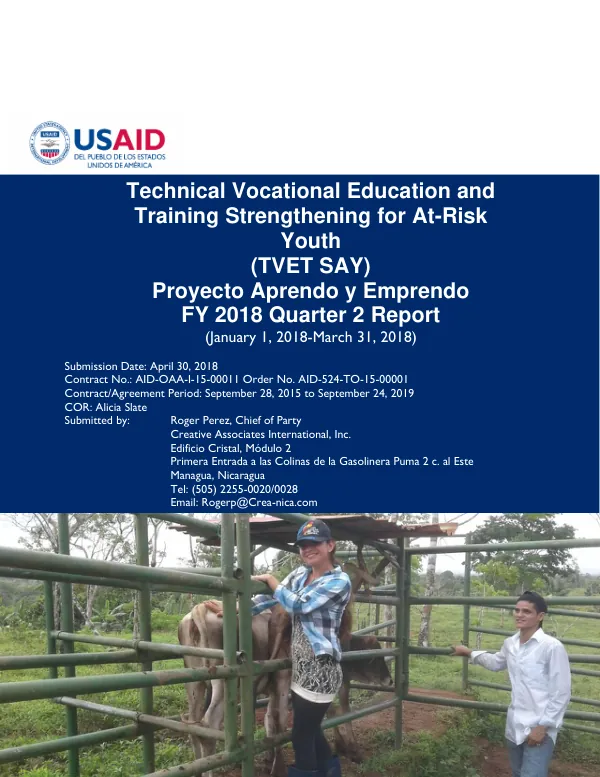
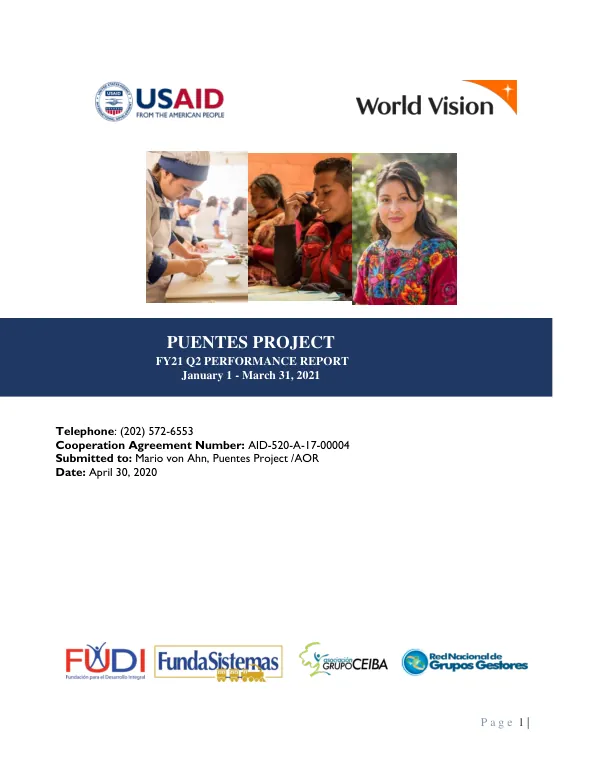
Technical Vocational Education and Training Strengthening for At-Risk Youth (TVET SAY) FY 2016 Quarter 3 Report
Sign inCREATIVE ASSOCIATES INTERNATIONAL INC.
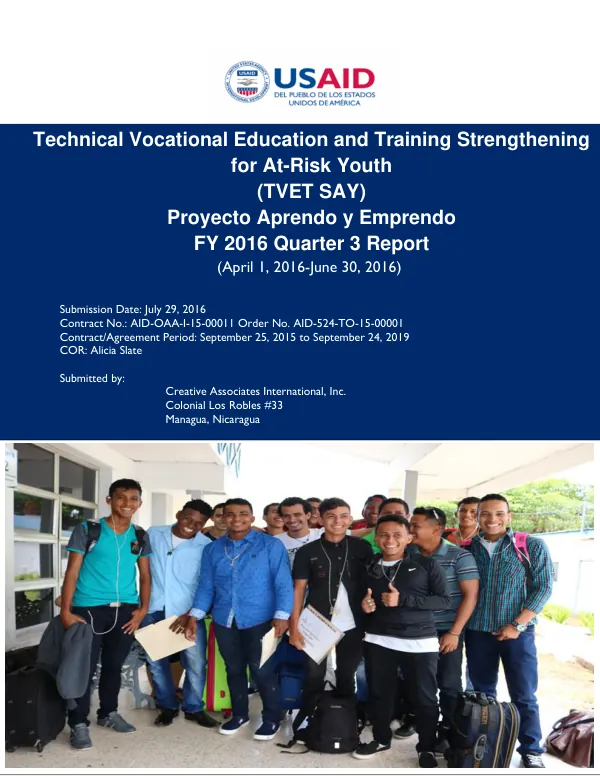
Technical Vocational Education and Training Strengthening for At-Risk Youth (TVET SAY) FY 2016 Quarter 3 Report
The Technical Vocational Education and Training Strengthening for At-Risk Youth (TVET SAY) project is a four-year effort focused on strengthening institutions that offer technical and vocational education to benefit at-risk youth from the Caribbean Coast in Nicaragua.
2016 · 13 pages
Sign in to readA free account is required to download.
Abstract
The project goal is to improve security in the Caribbean Coast by providing youth with educational opportunities linked to jobs and livelihoods through strengthened educational centers that can educate youth in areas where there is a market demand. The TVET SAY project has four components with the following objectives: improve collaboration and information sharing among centers by establishing or strengthening a network of training centers; strengthen private TVET centers to be "model" institutions, providing organizational capacity building and creating private sector alliances; increase interest and perceived value of TVET programs through public awareness campaigns, especially along the Caribbean Coast; and increase socio-economic gains for at-risk youth from the Caribbean Coast while enabling safer environments. During the third quarter of Fiscal Year 2016, the team saw significant progress in foundational activities related to all four components. With respect to Component 1, the team launched the National TVET Network with 48 participants, which included leadership from 27 institutions: 14 TVET centers, 9 firms/business associations, and 4 civil society organizations. Participants discussed the core focus of the Network and priorities for the upcoming quarter. In line with Component 2, the team developed and signed Memoranda of Understanding (MOU) with seven selected TVET centers and facilitated an introductory workshop on the Organizational Capacity Assessment Tool (OCAT) and process. The team piloted, adapted, and improved the tool, and then applied it to the seven TVET centers. TVET SAY also made significant inroads with the private sector this quarter, meeting with numerous firms that have expressed interest in partnering with the program. The team received written confirmation that these companies want to collaborate by providing internship opportunities and scholarships for at-risk youth. For activities related to Component 3, TVET SAY started the quarter with a youth-led project launch attended by more than 200 stakeholders, which garnered significant media attention, leading to the publication of 20 articles about the program and TVET. The program continued to conduct youth outreach through social media, and had over 700 Facebook fans at the end of the period. The team continues to work through the youth perception survey and messaging and design of an outreach campaign. To kick off scholarships for Component 4, Fundación Victoria offered TVET SAY 15 full scholarships in late June (13 of which were awarded during the quarter) for youth from the Caribbean Coast to study to obtain a certification as mid-level industrial electricity technicians in Managua. The TVET SAY project identified 20 youth who were interested in pursuing this career to apply for the scholarships through local non-governmental organizations (NGOs) working with at-risk youth in the Southern Caribbean Cost Autonomous Region (RACCS) and the Northern Caribbean Cost Autonomous Region (RACCN). In addition, this quarter the team finalized the TVET SAY Monitoring and Evaluation (M&E) Plan, completed the baseline assessment that will provide initial values for the M&E system, and made progress toward developing an Information Management System for monitoring and evaluation. The National TVET Network was launched in collaboration with 48 participants, including leadership from 27 institutions: 14 TVET centers, 9 firms/business associations, and 4 civil society organizations. Roundtable discussions were held during the event to develop the core focus of the Network, develop short-term goals, and set a date for the next meeting. Participants showed a strong interest in a dialogue to discuss private sector needs and modernization of TVET offerings. A meeting was also held with the Caribbean Coast Youth Roundtable (MCJ) in Bluefields, with the goal of expanding access to the National TVET Network to the Caribbean Coast. The Roundtable is composed of universities, TVET centers, NGOs, and other training institutions. Roundtable members are interested in integrating and consolidating the network. The TVET SAY project has made significant progress in strengthening institutions that offer technical and vocational education to benefit at-risk youth from the Caribbean Coast in Nicaragua. The project has established a National TVET Network, strengthened private TVET centers, increased interest and perceived value of TVET programs, and increased socio-economic gains for at-risk youth from the Caribbean Coast while enabling safer environments.
Related documents