USAID. MISSION TO INDIA
Technologies for the rural poor
Evaluates project to develop technologies appropriate to rural development in India.
Berry, R. K.; Thormann, Peter · 1985
Sign in to readA free account is required to download.
Abstract
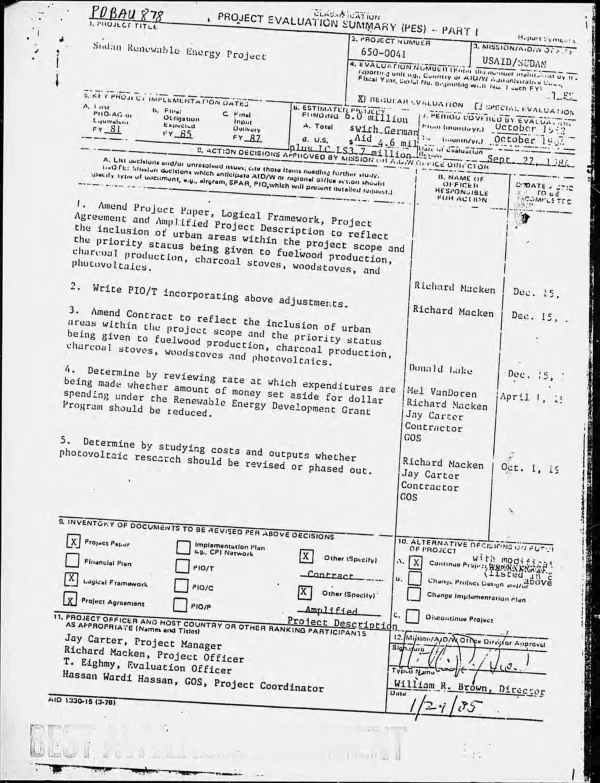
PES covers the period 8/78-12/84 and summarizes an attached special evaluation (XD-AAR-453-A) of four renewable energy subprojects (SP"s). Initial progress was very slow due to insufficiently specific guidance and criteria for SP approval and inadequate Government of India (GOI) and USAID/I staff attention. However, the guidelines were revised and adequate staff were placed in 1979-80. As of 12/81, four energy SP"s (representing 75% of project funding) and three other SP"s had been approved. The energy SP"s have effected significant technology transfer, built up long-term institutional relationships, and established Indian centers of excellence in several areas of renewable energy research and application. The quality of technical research has been high and the technologies developed sound, although a number of technologies (e.g., the Salojipally village solar thermal energy SP) were too expensive and complex for remote site maintenance and operation. The general recommendations of the special evaluation are to: extend the four SP"s for 6-12 months to allow field testing; restrict U.S. collaborative assistance during the testing period to specific TA, performance monitoring, and cost-reduction activities by commercial producers; and call for USAID/I and India"s Department of Non Conventional Energy Sources (DNES) to jointly fund a careful economic analysis and market study of each technology system developed under the project to determine whether broader demonstration or commercialization is warranted. Key action decisions are to (given DNES concurrence) extend the project one year (through 12/86) to permit field testing of technologies; and, after completion of field testing, to conduct economic analyses and market studies for the solar drying and mini-hydro SP"s.