TETRA TECH
Tenure and Global Climate Change (TGCC) Quarterly Report, April – June 2017
The Tenure and Global Climate Change (TGCC) task order is funded by the United States Agency for International Development (USAID) under the Strengthening Tenure and Resource Rights (STARR) Indefinite Delivery/Indefinite Quantity Contract (IDIQ).
2017 · 79 pages
Sign in to readA free account is required to download.
Abstract
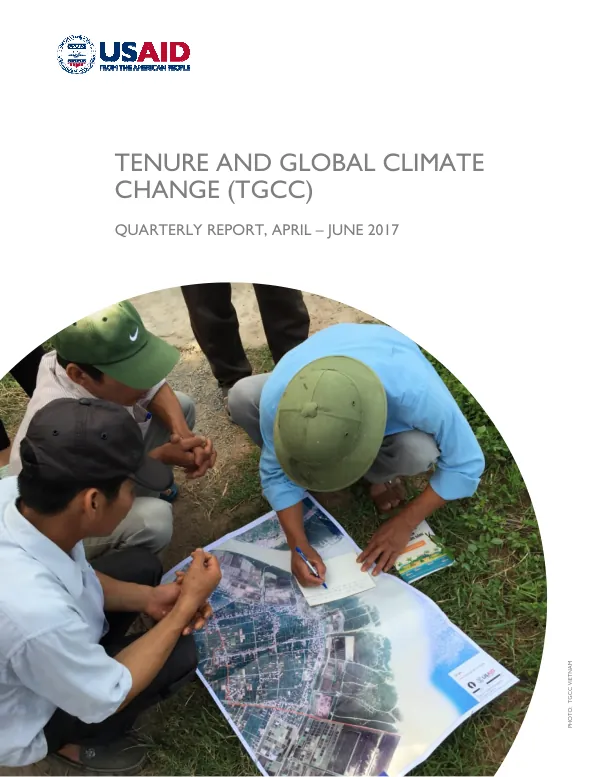
The aim of the task order is to identify and test models that strengthen resource governance and property rights as they relate to programming that reduces deforestation and forest degradation and increases the resiliency of vulnerable populations. The impacts of social and environmental change and society's responses are significantly affecting resource tenure governance, the rights of communities and people, and their livelihoods. In turn, resource tenure and property rights issues may strengthen or undermine successful implementation of initiatives to respond and adapt to global changes. Interventions that strengthen resource tenure and property rights governance can help reduce vulnerability and increase resilience. They also promote resource-use practices that achieve mitigation, and development objectives. The task order consists of four tasks and contains a grants under contract mechanism to support these task areas. These tasks aim to pilot tenure interventions that strengthen land rights as an enabling condition for the promotion and adoption of sustainable land use practices through work in the Chipata and Petauke Districts of Zambia's Eastern Province. The work has also evolved to support policy engagement and research around customary land administration in Zambia. Clarifying the legal and regulatory rights to benefits derived from environmental services under REDD+ and other Payment for Environmental Services incentives is another key objective. This involves resource tenure and REDD+ assessments, as well as targeted legal assistance to the development of a national land use policy and associated laws in Burma. The work has evolved to consider tenure conditions associated with the sustainable management of mangrove systems and their environmental services. Research on tenure, property rights, and climate change mitigation and adaptation is also a critical component of the task order. This research focuses on the devolution of ownership and governance of forests, the devolution of marine resource tenure rights, and the tenure dimensions around reducing deforestation in commodity supply chains associated with the Tropical Forest Alliance (TFA) 2020 initiative. Strengthening women's property rights under REDD+ is another key objective of the task order. This involves support to customary land mapping and planning pilot processes, as well as piloting the recognition of community rights over land and resources in diverse agricultural/forest landscapes in Burma. The work has also evolved to consider the recognition of women's property rights in coastal mangrove management in Vietnam. TGCC is addressing these tasks by using a combination of intensive field implementation, local partnerships, field work, and case studies, literature reviews, participation in international communities of practice, and workshops and conferences. The project is supervised by USAID's Land and Urban Office and has a global focus coordinated with and through USAID missions and other international organizations. The project has made significant progress in the first quarter of 2017, with activities implemented in Zambia, Burma, and Vietnam. The project has also established partnerships with local organizations and communities, and has conducted research and assessments on tenure, property rights, and climate change mitigation and adaptation. The project's findings and recommendations will inform policy and programming decisions at the national and international levels. In Zambia, the project has supported the development of a national land use policy and associated laws, and has conducted research on customary land administration. The project has also worked with local communities to strengthen their land rights and promote sustainable land use practices. In Burma, the project has clarified the legal and regulatory rights to benefits derived from environmental services under REDD+ and other Payment for Environmental Services incentives. The project has also supported the development of a national land use policy and associated laws, and has conducted research on tenure conditions associated with the sustainable management of mangrove systems and their environmental services. In Vietnam, the project has supported the piloting of recognition of community rights over land and resources in diverse agricultural/forest landscapes, and has considered the recognition of women's property rights in coastal mangrove management. The project has also established partnerships with local organizations and communities, and has conducted research and assessments on tenure, property rights, and climate change mitigation and adaptation. Overall, the TGCC project has made significant progress in the first quarter of 2017, and is well-positioned to achieve its objectives and inform policy and programming decisions at the national and international levels.