PATHFINDER INTERNATIONAL
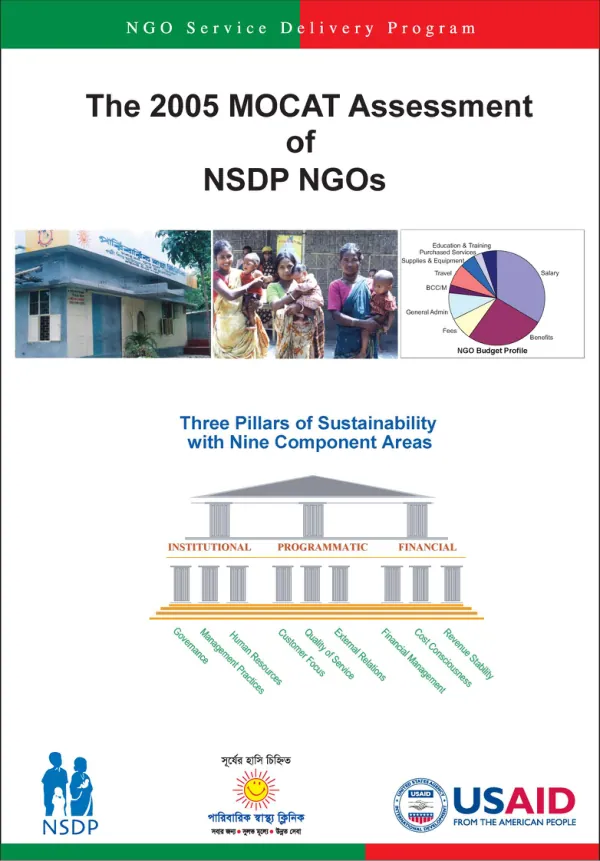
The 2005 MOCAT assessment of NSDP NGOs
The NGO Service Delivery Program (NSDP) uses the Modified Organizational Capacity Assessment Tool (MOCAT) to gauge the development of project NGOs.
1970
Sign in to readA free account is required to download.
Abstract
A baseline external assessment was conducted in 2003 and follow-up self-assessments took place in both 2004 and 2005. Since 2003, scores have increased in all component areas and consequently in all three "pillars" of sustainability -- institutional, programmatic and financial. Project NGOs use MOCAT as a planning tool, identifying areas of weakness and making necessary adjustments. Between 2003 and 2005, the composite MOCAT score for project NGOs1 increased from 1.75 to 2.21 -- an increase of 26%. In 2003, two NGOs were rated as "nascent", 22 were rated as "emerging", and 6 were rated as "expanding". None of the NGOs were rated "mature". But by 2005, all the NGOs had developed sufficiently that none were classified as nascent, 5 NGOs were rated as emerging, and 25 NGOs rated as expanding. Still, in 2005 no NGOs were able to advance to the "mature" category. In 2005 the NGOs scored highest in the programmatic pillar, especially in the areas of culture of quality and external relations but lowest in the institutional pillar, especially in governance and management practices. In the financial pillar, NGOs scored higher in the area of financial management, but lower on cost consciousness measures. All project NGOs continue to improve, some more rapidly than others. The larger and more sophisticated NGOs with strong managements and a diverse client base are better positioned to make significant improvements in overall organizational and financial sustainability. (Author abstract)
Related documents