USAID. BUR. FOR PROGRAM AND POLICY COORDINATION. CENTER FOR DEVELOPMENT INFORMATION AND EVALUATION (CDIE)
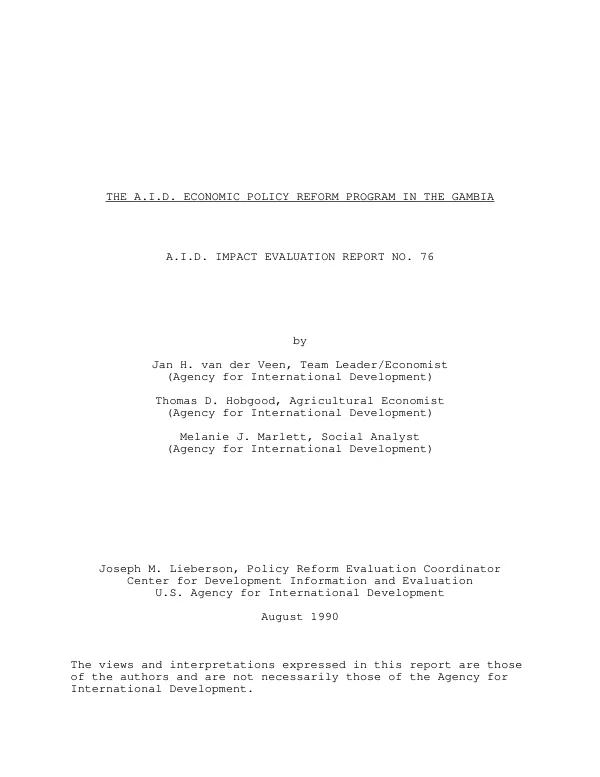
The AID economic policy reform program in The Gambia
In 1987, A.I.D.
van der Veen, Jan H.|Hobgood, Thomas D.|Marlett, Melanie J. · 1990
Sign in to readA free account is required to download.
Abstract
provided The Gambia with a $6 million grant to support a series of financial and agricultural marketing reforms as part of a multi-donor economic reform program. The sectoral reforms were designed to encourage greater private sector involvement in productive activities and discourage the Government from regulating and controlling activities that could most efficiently be done by the private sector. Specifically, the Government of The Gambia agreed to: implement appropriate policies regarding term lending, agricultural credit, and development lending; enforce market-determined interest rates; prohibit preferential access to credit; and ensure equal allowances for all buyers involved in agricultural marketing. After only two years, it is too early to determine the effects of this complex policy reform program. However, it is evident that the program faces a number of barriers: (1) an inadequate amount of technical assistance and institutional development; (2) poor donor coordination; (3) continued government control over fertilizer grants, which undermined the liberalization of groundnut marketing; (4) high interest rates; and (5) resistance to market reforms by government organizations and parastatals. On the other hand, several external factors have improved the economic climate and helped the reform process, including good weather, which helped improve agricultural production; a halt in the secular deterioration of the terms of trade; a strong pro- rural political bias; and satisfactory relations with neighboring Senegal.