ABT ASSOCIATES
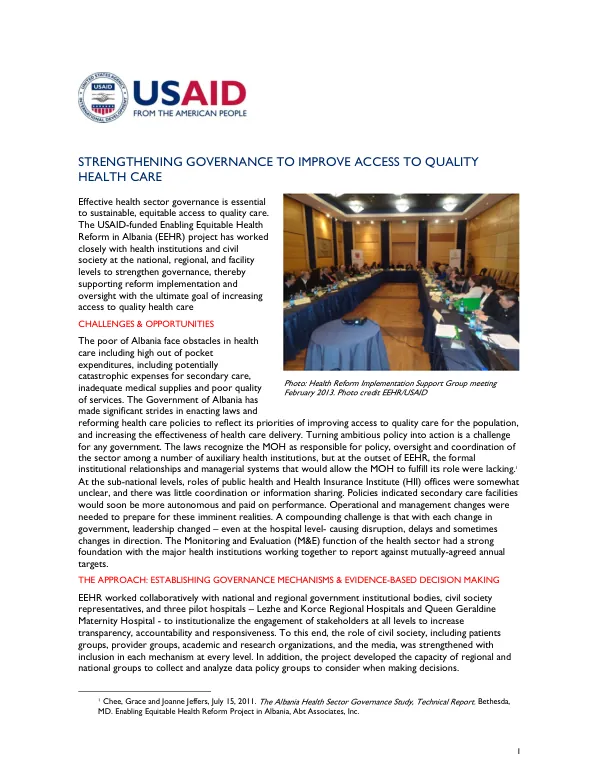
The Albania Health Sector Governance Study Technical Report
The Government of Albania has recently enacted a series of laws aimed at reforming the healthcare system and providing greater access to affordable, quality healthcare for all Albanians.
2011 · 59 pages
Sign in to readA free account is required to download.
Abstract
The Basic Health Care Law, Public Health Law, and the Law on Health Insurance define the roles and functional responsibilities of the Ministry of Health (MoH), Health Insurance Institute (HII), and other health sector institutions. Implementation of this legislative framework requires sound institutional governance. The Enabling Equitable Health Reforms (EEHR) Project, supported by USAID/Albania, is working to implement this legislative framework and advance the health reform process. The project undertook a Governance Review, an in-depth institutional review of the Health Insurance Institute (HII), and an assessment of the capacity of the health sector Monitoring and Evaluation (M&E) function to identify ways to best support the Government of Albania. This Governance Review assesses the state of the health reform process, areas of success, and barriers to effective implementation and recommends concrete measures to build institutional managerial capacity and improve governance. The review focused on four primary areas of responsibilities that are most critically affected by the changes in the health system: health system governance and leadership, standards and processes to ensure and improve quality, hospital organization, operations, and management, and financing and health insurance. The review approach considered these issues in terms of capability, accountability, and responsiveness (CAR). The review method included a key document review, followed by a two-person team conducting interviews with key informants over two weeks. The review team interviewed staff in various directorates and departments within the MoH and the HII, as well as officials of the National Center for Quality, Safety, and Accreditation (NCQSA), National Center for Continuing Education (NCCE), Institute of Public Health (IPH), and others. During the two weeks in-country, the review team visited Durres region and Kruje district, meeting with public health officials, HII staff, as well as staff in health facilities. The interviews aimed to fill information gaps identified during the document review and to validate actual practices related to implementation of reforms. Albania has made significant progress in its transition to single-payer health financing with universal coverage for all, using provider contracting mechanisms to ensure high-quality, cost-effective services. However, ensuring high-quality services for both rich and poor requires strong oversight to ensure appropriate implementation that supports achievement of the reform goals. To support this transition, the MOH must evolve from its historical role as provider of healthcare to steward, policymaker, coordinator, and advocate. The MOH has struggled with fulfilling this new role, and it is clear that capacity building is required throughout the institution. An ongoing culture of centralized, top-down authority further contributes to the lack of technical capacity. There is insufficient coordination and communication within the MOH, leaving staff with a lack of clear vision and direction, and limiting their ability to influence and mobilize others. While the MOH is still responsible for developing policies that they do not have budget or authority to implement, the roles and responsibilities of the regional and district health authorities are even less clear. The review identified several key findings and proposed responses to address the challenges facing the health sector in Albania. In the area of health system governance and leadership, the review found that the MOH needs to evolve its role from provider to steward, policymaker, coordinator, and advocate. The review recommended that the MOH build its capacity to provide oversight and ensure provision of quality health services. In the area of standards and processes to ensure and improve quality, the review found that the MOH needs to develop, disseminate, and implement standards, protocols, and clinical guidelines to improve quality. The review also found that the MOH needs to establish and implement a monitoring and evaluation system to track progress and identify areas for improvement. In the area of hospital organization, operations, and management, the review found that the MOH needs to develop a comprehensive plan for hospital sector development, including financing and management. The review recommended that the MOH build its capacity to provide oversight and ensure provision of quality health services in hospitals. In the area of financing and health insurance, the review found that the MOH needs to develop a comprehensive plan for health financing, including registration of eligible population, collection of premiums, and definition of benefits package. The review recommended that the MOH build its capacity to provide oversight and ensure provision of quality health services in the health insurance sector. Overall, the review found that the MOH needs to build its capacity to provide oversight and ensure provision of quality health services in all areas of the health sector.
Related documents