USAID DEC
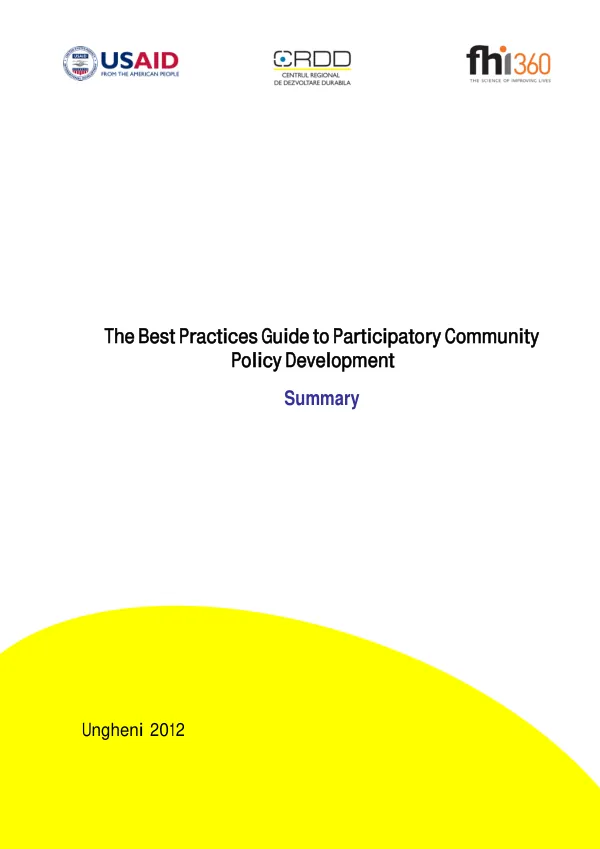
The Best Practices Guide to Participatory Community Policy Development
The Best Practices Guide to Participatory Community Policy Development is a comprehensive guide aimed at supporting local public administrations in developing public policies through citizen participation.
2012 · 110 pages
Sign in to readA free account is required to download.
Abstract
The guide provides a framework for involving citizens in the decision-making process, which is essential for improving the welfare of the community. In the context of public administration in the Republic of Moldova, the process of improving local government according to the principles of the Law No. 435 on Administrative Decentralization dated 28.12.2006, involves consulting and involving citizens in the process of exercising exclusive competence. The experience shows that efficient and effective local public authorities, with active and direct citizen involvement, increase the chances of locality development, leading to a positive impact on reducing corruption among officials and local officers. A local public policy has distinct features, including a set of concrete measures, decisions on resources allocated, a general action framework, and goals and objectives formulated in terms of certain norms and values. The goal of a public policy contains a declaration of what the policy intends to do, who and how will be affected by its implementation, and within established deadlines. The goal is achieved by attaining specific objectives, which are concrete and measurable, allowing for monitoring and efficient assessment of results. In the context of local public policy, beneficiaries represent any target individual, community, or social group directly or indirectly affected by policy implementation. At the first stage, it is necessary to exhaustively enumerate the relevant groups, analyze them, and subsequently involve local public authorities in the process of development and formulation of the respective public policy. Consultations play a crucial role in increasing transparency of the decision-making process and accumulating useful information about the proposal of local public policy. The analysis of consulted groups and organizations is essential for making the results of consultations contribute significantly to the achievement of objectives of local public policy. The types of resources interest groups may have include financial and material resources, access or control over important information, and social status or position. The methods of consultations stipulated in the Law No. 239 dated 13.11.2008 on transparency in the decision-making process can be used for consultation in case of draft decisions. The most efficient methods of consultations include public opinion polling, public hearings, and roundtable discussions, which can be used depending on the scale and contents of the local public policy. The guide emphasizes the importance of partnerships between local public authorities and non-governmental organizations in the development and implementation of local public policies. The advantages of such partnerships include increased transparency, accountability, and efficiency in the decision-making process. Local public authorities and non-governmental organizations can work together to achieve common goals and objectives, leading to improved community welfare. The implementation of local public policies involves several stages, including the establishment of an agenda, identification and formulation of the problem, identification of variants of solution, and choice of the best solution. The process of formulation of local public policies is influenced by the agenda and the selection of the solution to settle the problem. The implementation of local public policies is a critical stage that requires careful planning and execution. The monitoring and evaluation of local public policies are essential for assessing the effectiveness of the policies and making necessary adjustments. Non-governmental organizations play a crucial role in monitoring and evaluating local public policies, providing valuable insights and recommendations for improvement. In conclusion, the Best Practices Guide to Participatory Community Policy Development provides a comprehensive framework for involving citizens in the decision-making process and improving community welfare. The guide emphasizes the importance of partnerships between local public authorities and non-governmental organizations, efficient methods of consultations, and careful planning and execution of local public policies.