USAID DEC
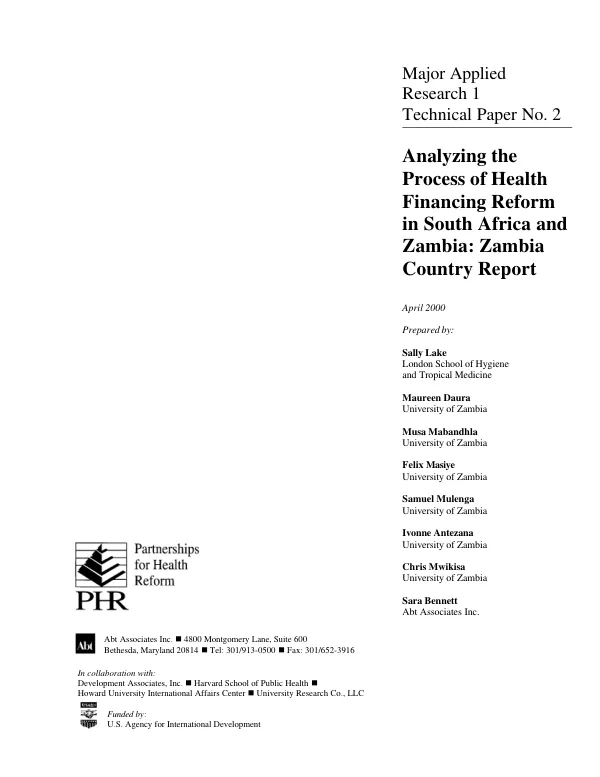
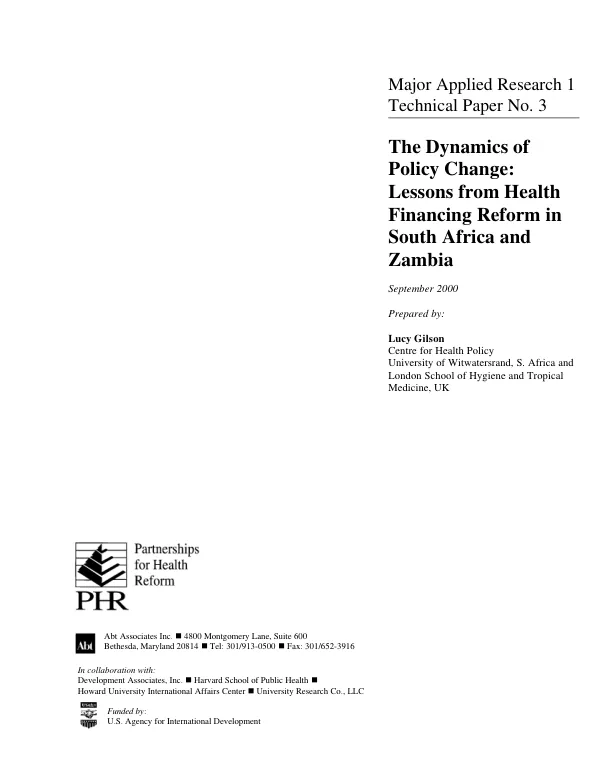
The dynamics of policy change : lessons from health financing reform in South Africa and Zambia
Sign inABT ASSOCIATES, INC.
The dynamics of policy change : lessons from health financing reform in South Africa and Zambia
This report analyzes health care financing reform in South Africa and Zambia during the 1990s.
Gilson, Lucy; Antezana, Ivonne · 2000
Sign in to readA free account is required to download.
Abstract
The policies examined include the development and application of resource allocation formulae and a range of resource mobilization reforms. In some respects, these reforms promoted equity and system sustainability. For example, in both countries public sector budgets were reallocated in ways that promoted equity (and, in Zambia, allocative efficiency). Negative impacts included reversals over time in South African geographical equity gains and reduced health care utilization levels in Zambia. Important gaps in policy action were also identified in both countries. The critical factor underlying these experiences was the processes of decisionmaking surrounding the policy changes, which were bound by context and yet strongly shaped by key political and technical actors. The particular interests and concerns of these actors, as well as their corresponding responses to the design details of the reforms, explain the positions they took on the reforms of focus. In addition, their relative power largely explains their ability to block or mobilize support for policy change, although this was sometimes mediated by the particular strategies of policy development and implementation employed in decisionmaking. Reflection on the above factors yielded 10 lessons on ways to strengthen decisionmaking regarding health care financing issues. These are as follows: (1) Make financing policy change an integral part of health system development, because it has a wide-ranging influence over the patterns of health care provision and use, affects popular support for such change, and must itself be complemented by parallel institutional changes. (2) Pay attention to the "art" of politics and not just the "science" of technical analysis. (3) Use a balanced mix of open (public) and closed policy processes. (4) Develop wide- ranging strategies of information gathering. (5) Apply strategies and tactics. Because actors strongly influence the pattern of policy change, their interests and concerns must be actively considered in identifying strategies that build support for change, while offsetting opposition. (6) Balance strong political leadership with effective technical capacity. (7) Establish clear roles for all technicians and analysts. (8) Take account of implementation needs in policy development. Implementation does not automatically follow policy development, but requires deliberate planning and policy management skills. (9) Enable further policy change through the approach to implementation, e.g., by prioritizing policy actions, sequencing the implementation of complex changes, and planning for implementation. (10) Put monitoring and evaluation at the center of implementation.
Related documents