USAID DEC
The Impact of Narrative Feedback, E-Learning Modules and Realistic Video and the Reduction of Misconception
Sign inUNIVERSITAS SYIAH KUALA
The Impact of Narrative Feedback, E-Learning Modules and Realistic Video and the Reduction of Misconception
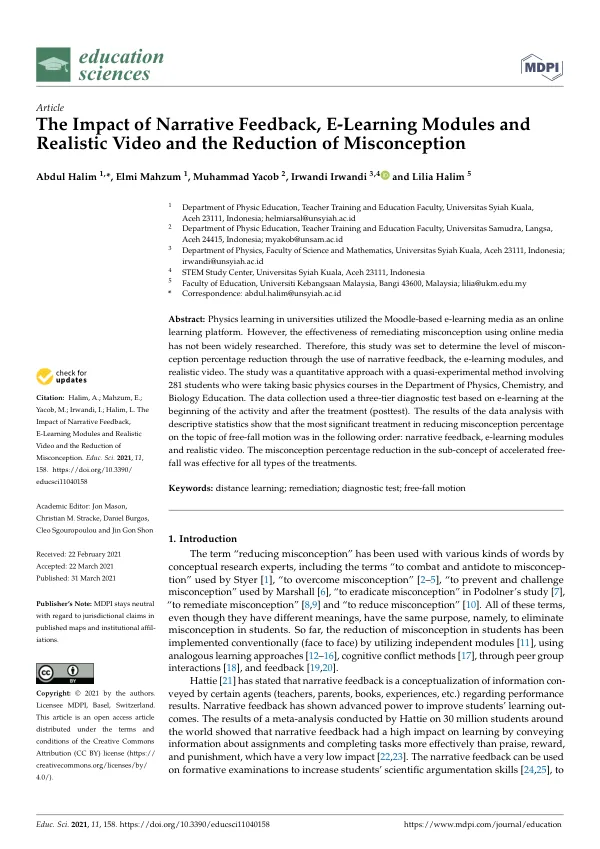
Physics learning in universities utilizes Moodle-based e-learning media as an online learning platform.
2021 · 14 pages
Sign in to readA free account is required to download.
Abstract
However, the effectiveness of remediating misconception using online media has not been widely researched. This study aimed to determine the level of misconception percentage reduction through the use of narrative feedback, e-learning modules, and realistic video. The study involved 281 students taking basic physics courses in the Department of Physics, Chemistry, and Biology Education. The research design was a quantitative approach with a quasi-experimental method and a three-group pretest and posttest design. The sample consisted of first-year students from the Department of Physics Education, Biology Education, and Chemistry Education. The students were divided into three groups: Group Phys. 1-Phys. 3, Phys. 4-Phys. 5, and Phys. 6-Phys. 9. The total sample size was 281 respondents. Narrative feedback has been shown to have a high impact on learning outcomes, conveying information about assignments and completing tasks more effectively than praise, reward, and punishment. The study of reducing misconception using narrative feedback based on Moodle's e-learning is one of the novelties of this study. Narrative feedback can be used on formative examinations to increase students' scientific argumentation skills, understand teacher-students perceptions and relationships, and design teaching strategies in higher education. E-learning technology has been widely used as online-based learning media in the form of learning modules and online computer-assisted tests. E-learning modules have been used to see the impact on students' knowledge and skills, students' involvement and attendance in the learning process, students' learning outcomes, understanding, and motivation. Realistic video is an interactive learning medium that has the convenience of analyzing the graphics of moving objects, free-falling objects, and determining moments of inertia. The study aimed to determine the effectiveness of misconception remediation using narrative feedback, e-learning modules, and realistic video as seen by misconception reduction or posttest results' score increase on the free-fall motion concept. The research questions in this study were: Q1: What percentage is the pretest contribution to the posttest score in each treatment (narrative feedback, e-learning modules, and realistic video)? Q2: How does the treatment (narrative feedback, realistic video, and e-learning module) affect the increase in posttest scores? Q3: How does the treatment (narrative feedback, realistic video, and e-learning modules) affect the misconception percentage reduction? Q4: How is the relationship between the free-fall motion sub-concept and the type of treatment viewed from the point of view of misconception reduction? The results of the data analysis with descriptive statistics showed that the most significant treatment in reducing misconception percentage on the topic of free-fall motion was in the following order: narrative feedback, e-learning modules, and realistic video. The misconception percentage reduction in the sub-concept of accelerated free-fall was effective for all types of the treatments. The study found that narrative feedback was the most effective treatment in reducing misconception percentage, followed by e-learning modules and realistic video. The results of this study contribute to the field of misconception remediation research and provide insights into the effectiveness of narrative feedback, e-learning modules, and realistic video in reducing misconception.