USAID DEC
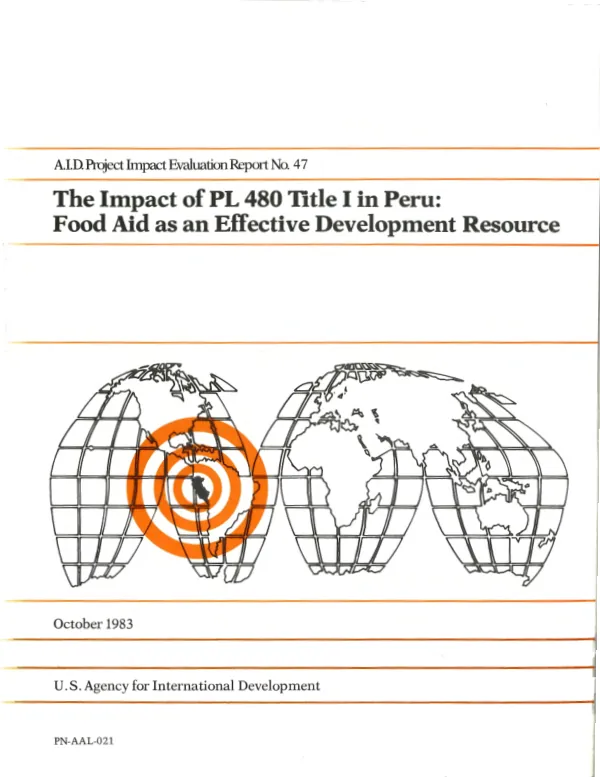
The impact of PL 480 Title I in Peru : food aid as an effective development resource
Sign inUSAID. BUR. FOR PROGRAM AND POLICY COORDINATION. OFC. OF EVALUATION
The impact of PL 480 Title I in Peru : food aid as an effective development resource
Peru's experience with P.L.
Johnson, Twig|Hammergren, Linn|Berry, Elizabeth B.|Landmann, Robert|Cohen, Judy|Adler, Robert · 1983
Sign in to readA free account is required to download.
Abstract
480 Title I food aid provides some important lessons, especially regarding USAID/P's success in integrating Title I into overall A.I.D. assistance. The Title I program's in-country context, key elements, and impacts in Peru, 1978-83, are herein reviewed. While it is difficult to isolate Title I impacts on agricultural production or nutritional status, several results of long-term importance can be noted. USAID/P's use of Title I-generated local currency to provide counterpart funding has kept USAID/P development projects fully funded in times of economic crisis, allowed the Mission to respond quickly to new initiatives and special projects, leveraged additional Government of Peru (GOP) resources into successful projects launched with the help of Title I resources, and, perhaps most importantly, significantly increased funding for PVO Food for Work projects. Its inclusion as part of the U.S.-GOP project level dialogue indicates Title I's integration into the total USAID/P program. On the other hand, the year-to-year uncertainty of Title I resources makes programming hazardous, sometimes forcing projects to be terminated or reduced, even, as in the case of reforestation, to the jeopardy of previous gains. Further, USAID/P development objectives seem to carry no weight in AID/W program decisions. The program's instability is further increased by the sometimes conflicting aims pursued by the many agencies defining yearly programs and by U.S. and GOP staff and institutional changes. It is noted that the actions of special interests (such as the U.S. rice lobby in 1982), when not coordinated through Embassy channels, can jeopardize U.S. foreign policy interests. A pilot 3-4 year Title I program is recommended in order to eliminate program uncertainties and allow USAID/P to exert greater policy leverage, e.g., in reforming agricultural credit policies, and to allow the programming of local currencies to be integrated with the Peruvian budget cycle rather than the Title I cycle. Appendices include, inter alia, overviews of Peru's economic situation since 1968, of P.L. 480 programs, and of the uses of local currency 1955-65 and 1979-82, and a 67-item bibliography (1961-82).
Related documents