USAID
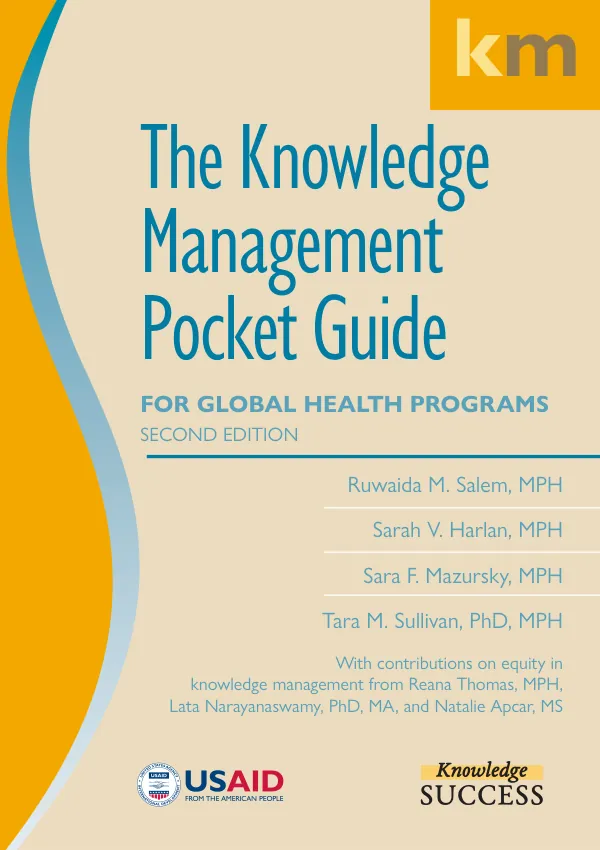
The Knowledge Management Pocket Guide for Global Health Programs
The Knowledge Management Pocket Guide for Global Health Programs is a comprehensive resource designed to help global health program staff apply knowledge management (KM) systematically and strategically in their programs.
2022 · 31 pages
Sign in to readA free account is required to download.
Abstract
The guide provides a basic overview of the Knowledge Management Road Map, a five-step systematic process for generating, collecting, analyzing, synthesizing, and sharing knowledge. The Knowledge Management Road Map focuses on KM as a process, not just a single product or activity, and guides the global health workforce in applying KM systematically and strategically in their programs. The Road Map consists of five steps: Assess Needs, Design Strategy, Create and Iterate, Mobilize and Monitor, and Evaluate and Evolve. These steps are designed to support and enhance KM and ongoing learning for more effective program implementation. Equity is a key consideration throughout all steps of the Knowledge Management Road Map, as well as in broader KM systems and processes. The guide emphasizes the importance of equity in KM for health programs, which is defined as the absence of unfair, avoidable, and remediable differences in knowledge creation, access, sharing, and use among groups of health workforce members. The guide also introduces the concept of the audience in global health programs, which refers to the global health workforce, including internal project or organizational staff members, external partners, networks, and the broader global health community. The guide highlights the importance of understanding the audience and tailoring KM strategies to meet their needs. KM tools and techniques can range from activities that focus on collecting knowledge, such as databases and resource centers, to connecting people to that knowledge through communities of practice, conferences, or social media. The guide presents a matrix of KM tools and techniques, which can be categorized into four broad approaches: asking, telling, publishing, and searching. These approaches complement each other, and effective KM strategies will often use multiple approaches. The guide emphasizes the importance of equity in KM and provides a checklist for integrating equity into KM systems and processes. The checklist is designed to be used in conjunction with the Building Better Programs guide, which provides more detailed guidance on developing and implementing a systematic and equitable knowledge management strategy. Overall, the Knowledge Management Pocket Guide for Global Health Programs is a valuable resource for global health program staff who want to apply KM systematically and strategically in their programs. The guide provides a comprehensive overview of the Knowledge Management Road Map, equity in KM, and KM tools and techniques, and offers practical guidance on how to integrate equity into KM systems and processes.
Related documents