CAROLINA POPULATION CENTER AT THE UNIVERSITY OF NORTH CAROLINA AT CHAPEL HILL
Routine Health Information System Curriculum
Routine Health Information Systems (RHIS) are essential for monitoring, evaluating, and improving health system performance in low- and middle-income countries.
2017 · 1 pages
Sign in to readA free account is required to download.
Abstract
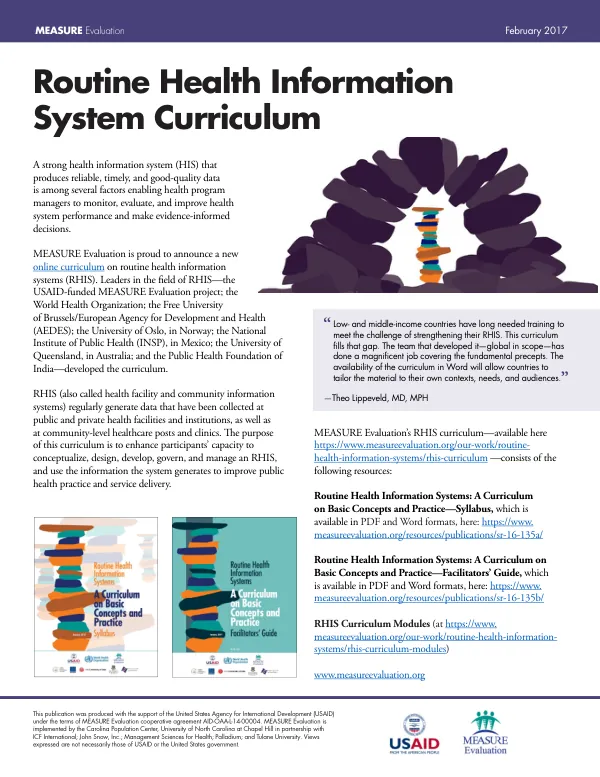
A strong RHIS produces reliable, timely, and good-quality data, enabling health managers to make informed decisions. The USAID-funded MEASURE Evaluation project, along with several international partners, developed a new online curriculum on RHIS to enhance capacity to design, develop, govern, and manage these systems. The curriculum aims to improve public health practice and service delivery by providing resources for health professionals to conceptualize, design, develop, and use RHIS. The curriculum consists of several components, including the Routine Health Information Systems: A Curriculum on Basic Concepts and Practice, available in PDF and Word formats, and the Routine Health Information Systems: A Curriculum on Basic Concepts and Practice—Facilitators' Guide, also available in PDF and Word formats. Additionally, the RHIS Curriculum Modules are accessible online. The curriculum is designed to be flexible, allowing countries to tailor the material to their specific needs, audiences, and audiences. The development team, comprising international experts, has covered the fundamental precepts of RHIS, providing a comprehensive resource for health professionals. The availability of the curriculum in Word format enables countries to adapt the material to their local context. The curriculum is a result of a collaborative effort between several international partners, including the World Health Organization, the Free University of Brussels/European Agency for Development and Health (AEDS), the University of Queensland, Australia, and the Public Health Foundation of India. The development of the curriculum was supported by the USAID under the terms of the cooperative agreement AID-OAA-L-14-00004. The publication was produced by the MEASURE Evaluation project, implemented by the University of North Carolina at Chapel Hill, in collaboration with ICF International, John Snow, Inc., Management Sciences for Health, Pall, and Tulane University. The views expressed in the publication are not necessarily those of the USAID or the United States government. Theo Lipperveld, MD, a renowned expert in RHIS, praised the curriculum as a magnificent achievement, covering the fundamental precepts of RHIS. The availability of the curriculum in Word format will enable countries to tailor the material to their specific needs and audiences, making it a valuable resource for improving public health practice and service delivery.
Related documents