USAID DEC
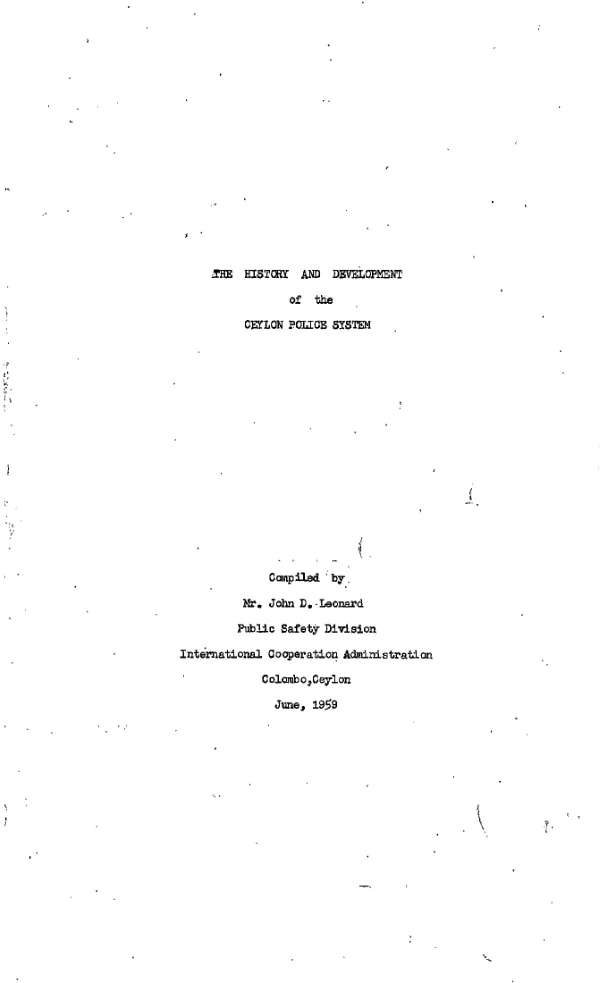
The Police System of Ceylon
The island of Ceylon, located off the south coast of India, is separated from the mainland by the Palk Strait and the Gulf of Mannar.
78 pages
Sign in to readA free account is required to download.
Abstract
Its length measures 270 miles, with a breadth of 150 miles, covering an area of 25,000 square miles. The estimated population is 9,000,000. The island's climate is characterized by monsoons, with the summer months being the exception. Exports include tea, rubber, coffee, coconuts, cinnamon, and tobacco, with sapphires being the primary source of revenue. The capital is Colombo, which was colonized by the Portuguese in the 16th century and later became a dependency of the Madras Presidency. The police system in Colombo was initially established in 1659, with the appointment of four soldiers to perform night patrol duties. However, the system was later taken over by the military, with the military responsible for law and order. An official, known as the Fiscal, was appointed to oversee the policing of Colombo, but the system was criticized for its inefficiency. A committee was formed in 1852 to investigate the police system, which found that the system was plagued by corruption and favoritism. The committee recommended the establishment of a paid police force, with the government responsible for funding and administration. However, the system was criticized for its inefficiency, with the committee finding that the police were often absent from duty and lacked alertness when on patrol. The committee's report highlighted the need for a more effective police system, with the establishment of a paid police force and the introduction of a more efficient system of taxation. The report also recommended the appointment of a police magistrate to oversee the policing of Colombo. However, the system remained unchanged, with the police continuing to be plagued by corruption and inefficiency. The island's geography and climate play a significant role in shaping its economy and society. The island's exports, including tea, rubber, and coffee, are a significant source of revenue. The capital, Colombo, is a major commercial center, with a diverse population of merchants, traders, and artisans. The island's history is marked by a series of colonial powers, including the Portuguese, Dutch, and British. The British established a police system in Colombo, which was later taken over by the military. The committee's report highlighted the need for a more effective police system, with the establishment of a paid police force and the introduction of a more efficient system of taxation. The island's population is diverse, with a mix of ethnic and linguistic groups. The majority of the population is Buddhist, with a significant minority of Hindus and Muslims. The island's economy is primarily based on agriculture, with a significant contribution from the export of tea, rubber, and coffee. The island's infrastructure is well-developed, with a network of roads, bridges, and canals. The capital, Colombo, is a major commercial center, with a diverse population of merchants, traders, and artisans. The island's climate is characterized by monsoons, with the summer months being the exception.