USAID/FFP
Humanitarian Assistance in Review South Asia | FY 2003 – 2012
Chronic conflict, earthquakes, recurrent seasonal storms, floods, droughts, and severe winter weather, as well as limited government response capacity, present significant challenges to vulnerable populations in South Asia.
2012 · 2 pages
Sign in to readA free account is required to download.
Abstract
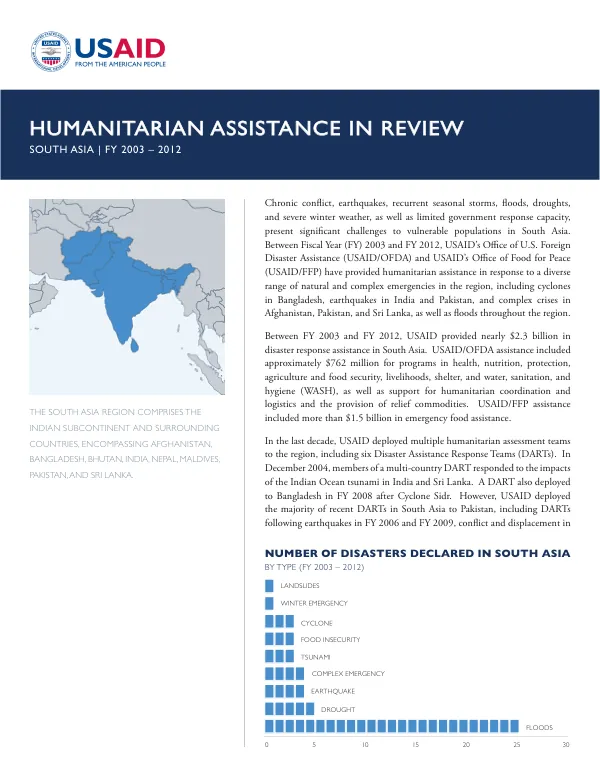
Between Fiscal Year (FY) 2003 and FY 2012, USAID's Office of U.S. Foreign Disaster Assistance (USAID/OFDA) and USAID's Office of Food for Peace (USAID/FFP) have provided humanitarian assistance in response to a diverse range of natural and complex emergencies in the region, including cyclones in Bangladesh, earthquakes in India and Pakistan, and complex crises in Afghanistan, Pakistan, and Sri Lanka, as well as floods throughout the region. Between FY 2003 and FY 2012, USAID provided nearly $2.3 billion in disaster response assistance in South Asia. USAID/OFDA assistance included approximately $762 million for programs in health, nutrition, protection, agriculture and food security, livelihoods, shelter, and water, sanitation, and hygiene (WASH), as well as support for humanitarian coordination and logistics and the provision of relief commodities. USAID/FFP assistance included more than $1.5 billion in emergency food assistance. In the last decade, USAID deployed multiple humanitarian assessment teams to the region, including six Disaster Assistance Response Teams (DARTs). A DART responded to the impacts of the Indian Ocean tsunami in India and Sri Lanka in December 2004, and another DART deployed to Bangladesh in FY 2008 after Cyclone Sidr. The South Asia region comprises the Indian subcontinent and surrounding countries, encompassing Afghanistan, Bangladesh, Bhutan, India, Nepal, Maldives, Pakistan, and Sri Lanka. The region experienced a significant number of disasters between FY 2003 and FY 2012, including cyclones, winter emergencies, food insecurity, landslides, tsunamis, earthquakes, floods, complex emergencies, and droughts. USAID/OFDA priorities include supporting and promoting activities to help reduce the vulnerability of populations at risk of climate-induced and human-made disasters, as well as to increase resilience to future shocks. USAID/OFDA has developed a Disaster Risk Reduction (DRR) strategy in the region to complement emergency assistance interventions and address the underlying causes of vulnerability. The strategy emphasizes building local capacity to prepare for and respond to disaster events. As such, USAID/OFDA programs reduce the impact of emergencies in the region by increasing the capacity of local emergency response agencies and personnel and enabling communities to recognize hazards through early warning systems. DRR programs include flood preparedness in Bangladesh and the Hindu Kush-Himalayan mountain region, earthquake risk management in Nepal, disease early warning systems in Pakistan, climate-risk management in India, and hazard mapping in Afghanistan. Through emergency and development food assistance programs, USAID/FFP works to save lives and reduce food insecurity in times of crisis and situations of chronic food insecurity. USAID/FFP emergency food assistance includes both in-kind food aid and cash-based assistance in the form of local and regional procurement of food commodities, cash transfers, and food vouchers, where market conditions allow. USAID/OFDA and USAID/FFP have provided significant funding to support humanitarian assistance in South Asia, with a total of $2.3 billion provided between FY 2003 and FY 2012.
Related documents