USAID DEC
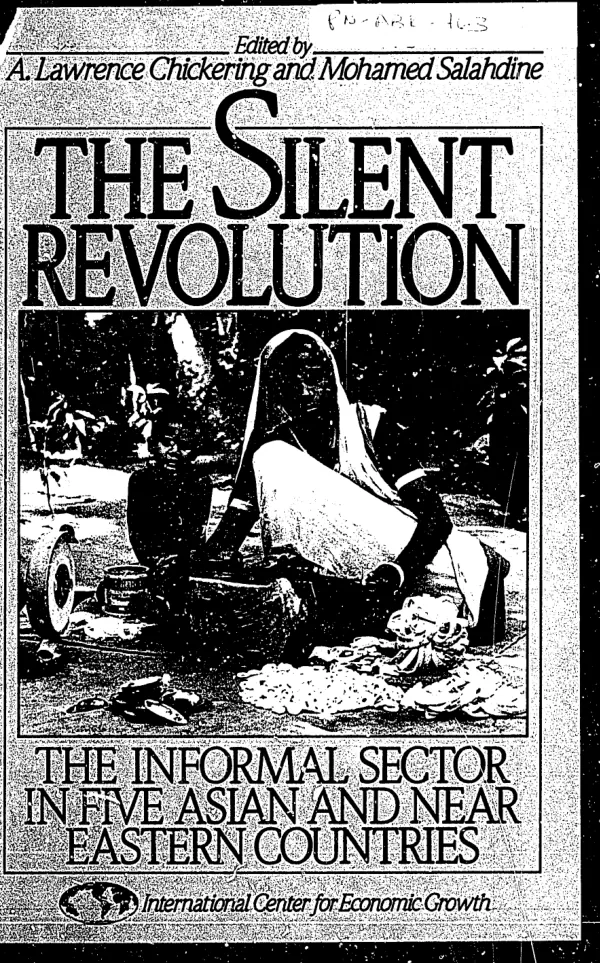
The silent revolution : the informal sector in five Asian and Near Eastern countries
Sign inHARVARD UNIVERSITY. HARVARD INSTITUTE FOR INTERNATIONAL DEVELOPMENT (HIID)
The silent revolution : the informal sector in five Asian and Near Eastern countries
In his landmark 1987 study of the informal sector in Peru, The Other Path, Hernando de Soto argued that government institutions and policies, supported by an implicit coalition of traditional conservatives and socialists, were systematically excluding the poor from employing their entrepreneurial skills and from participating fully in Peru"s economic and social life.
Chickering, A. Lawrence, ed.; Salahdine, Mohamed, ed. · 1970
Sign in to readA free account is required to download.
Abstract
The present work, a series of case studies of the informal sector in Bangladesh, Morocco, the Philippines, Sri Lanka, and Thailand, assesses the extent to which de Soto"s arguments can be extended to other developing countries. Major findings include the following. (1) In all five countries, the informal sector is enormously important, both economically and socially, accounting for over 50% of the work force and producing 40-60% of GDP. (2) Although overwhelmingly poor, informal workers are among the most extraordinarily entrepreneurial groups in their societies. (3) Except in prosperous Thailand, where the informal sector is declining, the lack of opportunity in the modern formal sector is attributed to economic policies that inhibit the growth of export sectors. (4) The existence of the informal sector stems from developing countries" postwar emphasis on building modern manufacturing and infrastructural sectors. (5) The informal sector holds the key to economic and political transformation in many developing countries and developed Marxist countries. It may exert its most powerful influence by reforging the vocabulary of economics, including terms such as capitalism, socialism, left, and right. The study also presents guidelines for governments in creating opportunities for informal workers and identifies areas for further research.