USAID DEC
The State of Viral Load Testing in Cambodia: An Assessment of Key Challenges and Opportunities
Sign inPEPFAR
The State of Viral Load Testing in Cambodia: An Assessment of Key Challenges and Opportunities
Cambodia's HIV epidemic is being successfully controlled through active case-finding strategies, increased coverage of antiretroviral therapy (ART), and high rates of viral load suppression.
2020 · 8 pages
Sign in to readA free account is required to download.
Abstract
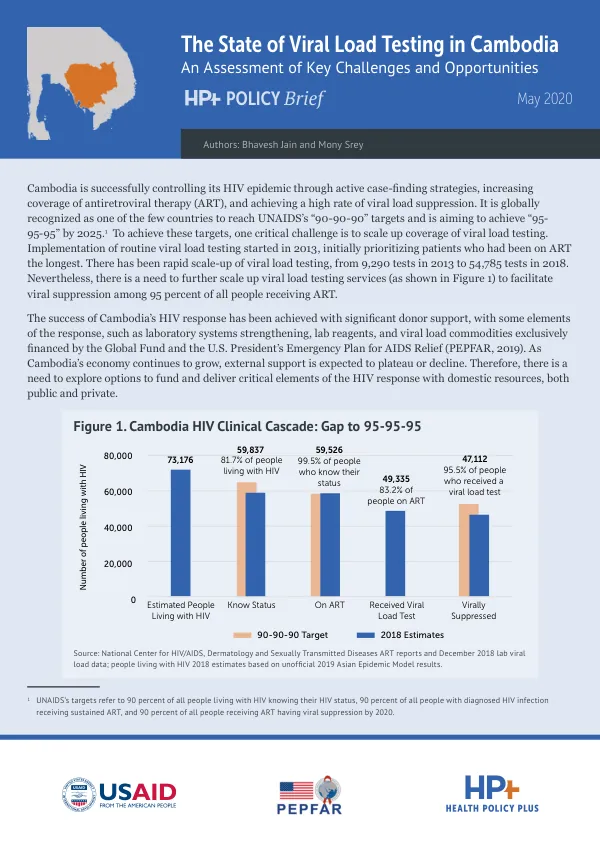
The country has achieved the UNAIDS "90-90-90" targets and is aiming to reach the "95-95-95" targets by 2025. To achieve this, scaling up coverage of viral load testing is critical. Routine viral load testing was implemented in 2013, initially prioritizing patients who had been on ART the longest. The number of viral load tests performed has increased rapidly, from 9,290 in 2013 to 54,785 in 2018. However, there is a need to further scale up viral load testing services to facilitate viral suppression among 95 percent of all people receiving ART. The success of Cambodia's HIV response has been achieved with significant donor support, including funding from the Global Fund and the U.S. President's Emergency Plan for AIDS Relief (PEPFAR). As Cambodia's economy continues to grow, external support is expected to plateau or decline, necessitating the exploration of options to fund and deliver critical elements of the HIV response with domestic resources. The State of Viral Load Testing in Cambodia is a policy brief that assesses key challenges and opportunities in the country's viral load testing landscape. The brief focuses on the potential for private sector engagement in viral load testing services, as the public sector has limited capacity to meet the growing demand for these services. The assessment was conducted through key informant interviews and review of secondary information available in reports produced by the National Center for HIV/AIDS, Dermatology and Sexually Transmitted Diseases (NCHADS) and other partners. Viral load testing coverage has increased over time, with 83.2 percent of people living with HIV on ART receiving at least one viral load test in 2018. However, there are inconsistencies in reporting, and some providers are not following viral load testing guidelines. The 2019 NCHADS Joint Program Review highlighted several issues related to the completeness and accuracy of reporting, as well as providers' adherence to viral load testing guidelines. The public sector has sufficient viral load testing capacity, with three testing machines operating in two public labs, capable of performing approximately 150,000 viral load tests per annum. However, the annual number of viral load tests required is expected to remain around 60,000 per year, depending on the number of new initiations. NCHADS has indicated that the private company from which they lease the machines is performing upgrades, which will further improve efficiency and increase capacity. Overall, Cambodia's HIV response has been successful in controlling the epidemic, but there are challenges related to viral load testing services. Scaling up coverage of viral load testing is critical to achieving the "95-95-95" targets, and private sector engagement may be a potential solution to meet the growing demand for these services.