USAID DEC
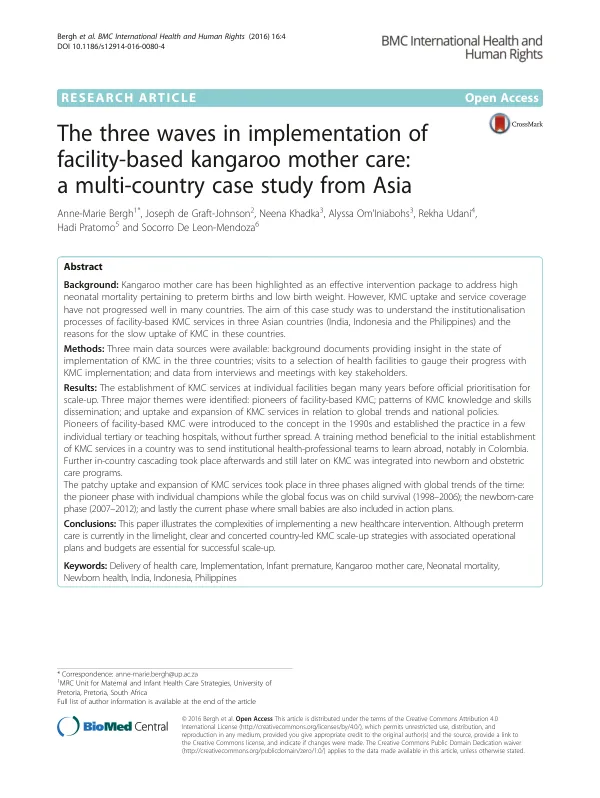
The three waves in implementation of facility-based kangaroo mother care: a multi-country case study from Asia
Sign inSAVE THE CHILDREN FUND
The three waves in implementation of facility-based kangaroo mother care: a multi-country case study from Asia
The establishment of facility-based kangaroo mother care (KMC) services in three Asian countries, India, Indonesia, and the Philippines, began many years before official prioritization for scale-up.
2016 · 13 pages
Sign in to readA free account is required to download.
Abstract
The pioneers of facility-based KMC were introduced to the concept in the 1990s and established the practice in a few individual tertiary or teaching hospitals, without further spread. A training method beneficial to the initial establishment of KMC services in a country was to send institutional health-professional teams to learn abroad, notably in Colombia. Further in-country cascading took place afterwards and still later on KMC was integrated into newborn and obstetric care programs. The patchy uptake and expansion of KMC services took place in three phases aligned with global trends of the time: the pioneer phase with individual champions while the global focus was on child survival (1998-2006); the newborn-care phase (2007-2012); and lastly the current phase where small babies are also included in action plans. The three main components of KMC are skin-to-skin position against a mother's or caregiver's chest, exclusive breastmilk feeding as much and as long as possible, and early discharge and ambulatory care with regular follow-up visits to a healthcare facility. Babies with a birth weight of less than 2500 g are the most vulnerable newborns at higher risk of mortality. Low birth weight is the result of being small for gestational age, preterm birth, or both. It is estimated that 32.4 million babies were born small for gestational age in 2010, of whom nearly 15 million were preterm. South and southeast Asia are the regions with the highest numbers of small for gestational age and highest preterm birth and death rates in the world. The study reported in this paper aims to contribute to a better understanding of the institutionalisation processes of facility-based KMC services at different levels of care and the reasons for the slow uptake of KMC and the scale-up of KMC services. The focus is on three countries in south and southeast Asia: India, Indonesia, and the Philippines. All three rank among the top 12 countries with the largest populations in the world and are high-burden countries with regard to low birth weight and preterm births and the associated morbidities and mortality. Data was collected from three main sources and focused on the state of KMC service provision. The data collection included the collection of background documents in the public domain, visits to a selection of health facilities to gauge their progress with KMC implementation, and interviews and/or meetings with key stakeholders. The study found that the leading cause of newborn deaths in all countries is preterm birth, and that neonatal death is the cause of approximately half of the under-five deaths in these countries.

![Asian urban disaster mitigation project [AUDMP]](https://covers.devme.ai/gen/16585.webp)