RTI INTERNATIONAL
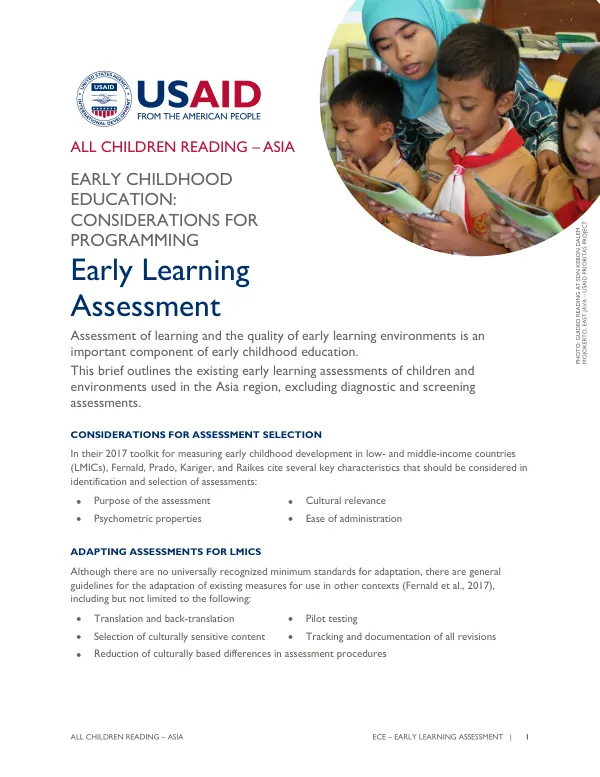
Early Learning Assessment for Early Childhood Education in Asia
Early childhood education plays a crucial role in determining the learning and development of young children.
2018 · 4 pages
Sign in to readA free account is required to download.
Abstract
In the Asia region, various assessments have been developed to measure child learning and development, as well as the quality of early learning environments. These assessments are essential for understanding the effectiveness of early childhood education programs and for making informed decisions about program development and implementation. Assessments of child learning and development typically involve direct measures or ratings from caregivers or teachers. Child-direct measures, such as the East Asia Pacific – Early Child Development Scales (EAP-ECDS), have been shown to be the least biased and to reveal the highest quality of data when gathered from a highly trained enumerator. However, these assessments typically require more resources and can be time-consuming to administer. The EAP-ECDS, for example, has been used in several countries in the Asia region, including Cambodia, China, and Mongolia, and measures various domains such as cognitive development, cultural knowledge, and socio-emotional development. Caregiver and teacher reports or ratings are another type of assessment that can be used to measure child development and learning. These assessments rely on caregiver and/or teacher reports of behaviors that are easy for caregivers and teachers to understand, observe, and describe. The UNICEF Multiple Indicator Cluster Surveys Early Child Development Index (MICS ECDI) is an example of a caregiver and teacher report assessment that has been used in several countries in the Asia region, including Bhutan, Bangladesh, and Vietnam. This assessment measures various domains such as learning, literacy and numeracy, and socio-emotional development. Assessments of the early learning environment are also essential for understanding the quality of early childhood education programs. These assessments typically include the measurement of structural and process indicators. Structural indicators include ratings of the physical aspects of the environment, such as the presence of teaching and learning materials, safety of the physical environment, and class size. Process indicators include ratings of interactions with children, such as instructional styles, emotional tone of the teacher, and communication between teacher and child. The Early Childhood Environment Rating Scale, Activities and Program Subscales – Revised (ECERS-R) is an example of an environmental assessment that has been used in several countries in the Asia region, including Indonesia and India. In conclusion, assessments of child learning and development, as well as the quality of early learning environments, are essential for understanding the effectiveness of early childhood education programs in the Asia region. These assessments can be used to inform program development and implementation, as well as to make informed decisions about resource allocation and policy development. Further research is needed to develop and adapt assessments that are culturally sensitive and relevant to the Asia region, and to increase our understanding of the components that make a quality early learning environment. The development of assessments for early childhood education in the Asia region has been influenced by various factors, including cultural and linguistic diversity, and the need for assessments that are sensitive to local contexts. The use of assessments such as the EAP-ECDS and the MICS ECDI has been shown to be effective in measuring child learning and development in the Asia region. However, further research is needed to develop and adapt assessments that are culturally sensitive and relevant to the Asia region. In addition to the development of assessments, there is a need for further research on the relationship between program inputs and their effect on the whole child, not just pre-literacy or pre-numeracy. This research can inform program development and implementation, as well as policy development, and can help to ensure that early childhood education programs in the Asia region are effective in promoting the learning and development of young children. Overall, the development and use of assessments for early childhood education in the Asia region are critical for promoting the learning and development of young children. Further research is needed to develop and adapt assessments that are culturally sensitive and relevant to the Asia region, and to increase our understanding of the components that make a quality early learning environment.