USAID DEC
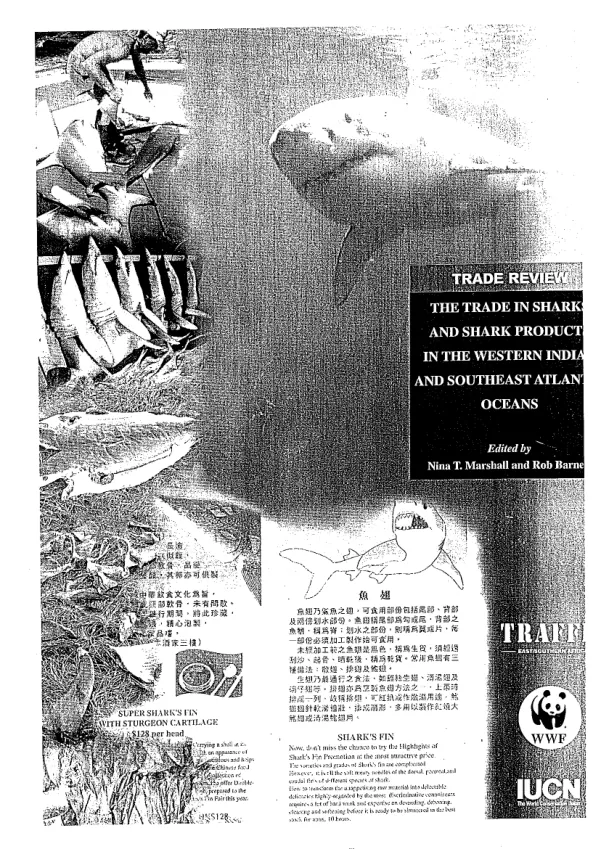
The trade in sharks and shark products in the Western Indian and Southeast Atlantic Oceans
Sign inIUCN-THE WORLD CONSERVATION UNION
The trade in sharks and shark products in the Western Indian and Southeast Atlantic Oceans
The objectives of the study were to identify and obtain available quantitative data on shark catches/landings and trade in shark products in the nine targeted countries in order to assess overall volumes and values of the trade, key harvest areas, individual shark species affected and their conservation status and other trade variables, including local uses and consumption, exports of shark products and illegal trade dynamics.
Marshall, Nina T.; Barnett, Rob · 1970
Sign in to readA free account is required to download.
Abstract
The results of the study were intended to put into perspective the status of shark fisheries in the western Indian and the southeastern Atlantic Oceans. The total western Indian Ocean production of marine and diadromous fish, crustaceans and mollusks has experienced a rising linear trend from 1,592,900 metric tons (MT) in 1970 to 3,394,959 MT in 1990. Based on 1990 catch and landing figures, sharks and rays represented 96,978 MT constituting 2.39% of the total marine production. This catch has remained relatively constant over the past three decades. Taking total catch figures from 1970, 1980 and 1990, the proportion of shark catch in 1990 coming from declining catches represented 23.9%, from stable catches 74.9% and from rising catches 1.3%. The total southeast Atlantic Ocean production of marine and diadromous fish, crustaceans and mollusks has experienced a decreasing linear trend from 2,459 974 MT in 1970 to 1,534,952 MT in 1990. The total annual catch of sharks and rays in 1990 represented 7,054 MT, which constituted 0.27% of the total marine production. Taking total catch figures from 1970, 1980 and 1990, the proportion of shark catch in 1990 coming from declining catches represented 56.7%, from stable catches 0.0%, and from rising catches 43.3% (Anon., 1993b). However, FAO"s catch statistics do not accurately assess shark catches, because bycatch is often under-reported. At the same time, harvest of sharks has generally been on the increase since the 1940s, due to an expanding market for fins and meat which has resulted in directed shark fisheries in certain areas. (Author abstract, modified)
Related documents