DELOITTE CONSULTING, LLP
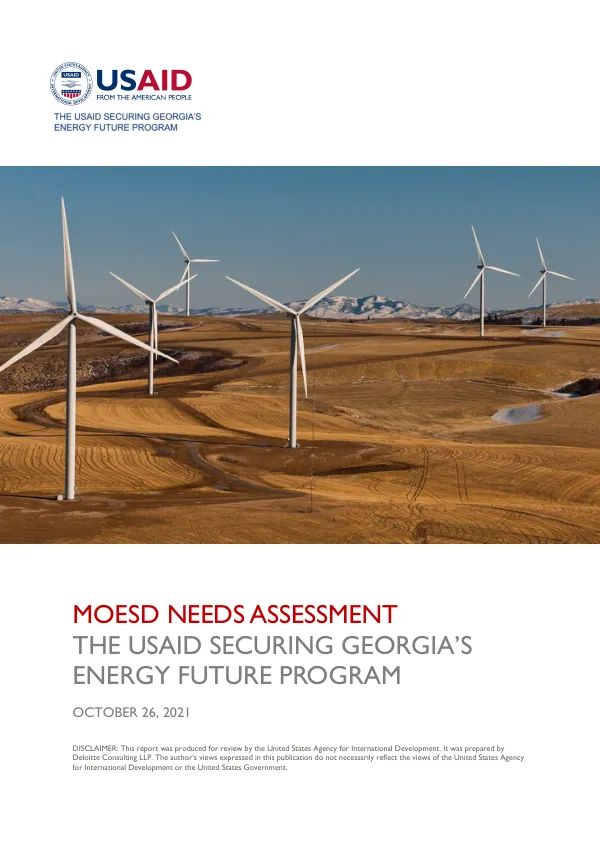
The USAID Securing Georgia’s Energy Future Program MOESD Needs Assessment
The USAID Securing Georgia's Energy Future Program is a program aimed at improving Georgia's energy security and reducing its susceptibility to malign influence.
2021 · 34 pages
Sign in to readA free account is required to download.
Abstract
The program's objective is to improve Georgia's energy security through sound long-term policymaking and governance, increased private-sector investment in indigenous renewable energy production, building the capacity of Georgian institutions to effectively and sustainably manage domestic energy markets, and improved energy sector resilience to cyber threats. The program is providing assistance to the Ministry of Economy and Sustainable Development (MoESD) in coordinating and drafting long-term national action plans for Georgia in line with Energy Community (EnC) requirements. The program conducted a Needs Assessment of the MoESD's Energy Reforms and International Relations Department to identify gaps in modeling and data management needs in connection with the development of the National Energy Policy, Energy Strategy, National Energy and Climate Plan (NECP), National Renewable Energy Action Plan (NREAP), National Energy Efficiency Action Plan (NEEAP), and other strategic action plans. The assessment identified significant needs and gaps in the energy modeling and data management capacity of the MoESD, which slow and complicate both the process and sectoral development. The identified gaps include a lack of background in advanced analytical modeling, modeling software tools lacking economic and social impact assessment modules, problems in data management and processing of energy information, and a lack of financial resources for people, office, and IT. The MoESD's energy department staff have received some training in the past, but they have yet to attain the level of knowledge to create integrated models and run exercises in scenario development. The currently employed energy modeling tools do not have the functionality to account for social and economic aspects of developments and changes in the energy sector. The Georgian energy sector lacks information sets readily available for collection, and the quality of the raw data may not be sufficient to be directly used as an input in energy planning processes. To address these needs and gaps, the program recommends that the MoESD ensure that the departments dealing with the energy sector are sufficiently staffed and have the institutional and human-resource capacities to make strategic decisions related to the future of the energy market and to develop and implement energy policies. The MoESD should start with the creation of a small analytical group, probably comprised of six-10 people, in which modelers will be present to develop and implement energy policies. The program also recommends that the MoESD start with the creation of a small analytical group to develop and implement energy policies. This group should be comprised of six-10 people, including modelers, to develop and implement energy policies. The group should be responsible for creating integrated models and running exercises in scenario development, as well as developing and implementing energy policies. The program's recommendations aim to improve the MoESD's energy modeling and data management capacity, which will enable the ministry to make informed decisions related to the future of the energy market and to develop and implement effective energy policies. Improved energy modeling capabilities are a requirement for Georgia on its path towards the EU, and the program's recommendations are designed to support Georgia's efforts to align its energy sector with EU directives and regulations. The program's recommendations are also designed to support Georgia's efforts to increase private-sector investment in indigenous renewable energy production, build the capacity of Georgian institutions to effectively and sustainably manage domestic energy markets, and improve energy sector resilience to cyber threats. By addressing the identified gaps in energy modeling and data management capacity, the program aims to improve Georgia's energy security and reduce its susceptibility to malign influence.