DELOITTE CONSULTING, LLP
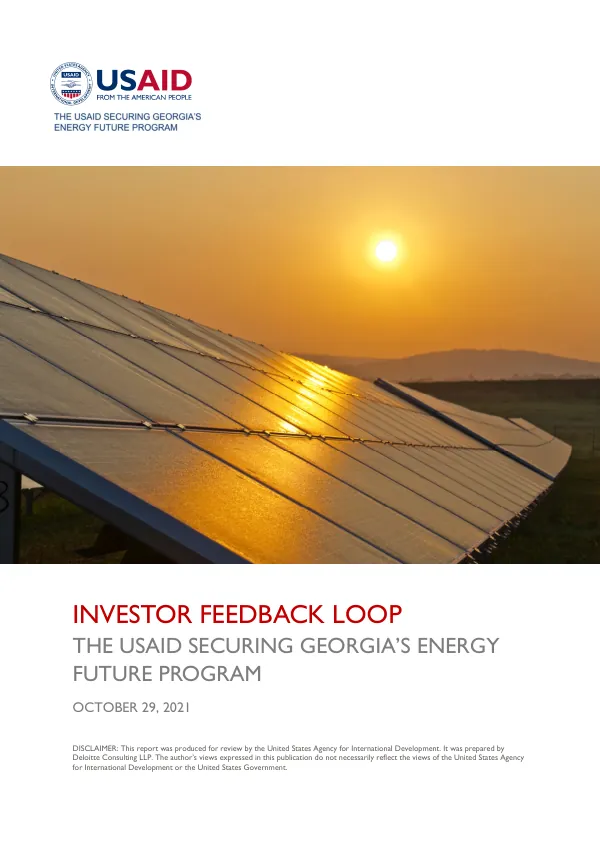
Investor Feedback Loop: The USAID Securing Georgia’s Energy Future Program
The energy sector in Georgia has significant potential for growth, with untapped hydro resources and opportunities for renewable energy sources.
2021 · 15 pages
Sign in to readA free account is required to download.
Abstract
The country's geographic location and trading opportunities with neighboring countries make it an attractive destination for investments. The government has implemented large-scale reforms in the energy sector, in compliance with the EU-Georgia Association Agreement and the Energy Community Treaty. The Ministry of Economy and Sustainable Development of Georgia has committed to harmonizing the Georgian energy market with its European counterpart, making it more open, competitive, and competitive for investments. Despite the potential and recent reform activity, sector reforms and significant investments have not kept pace, and Foreign Direct Investment (FDI) in the renewable energy sector has not increased. Thermal energy and imports have grown at the expense of hydropower and other alternatives. Private sector market players, developers, and investors have expressed concerns regarding the lack of a long-term clear energy policy, strategy, trading opportunities, and incentives. The Ministry of Economy and Sustainable Development of Georgia participates in public events, task forces, and informational campaigns, but it still needs a regular and reliable tool to keep its finger on the pulse of private sector developments and investor sentiment. To analyze the thoughts and views of private sector representatives, the USAID Securing Georgia's Energy Future Program spoke with a number of private investors, asking them to share their concerns and views on the country's renewable energy sector. The program has identified several challenges, including the lack of a long-term clear energy policy, strategy, trading opportunities, and incentives. The report also provides a discussion of and recommendation for developing an investor feedback loop to address these issues. The feedback loop would allow the Ministry of Economy and Sustainable Development of Georgia to incorporate investor insights into sector development. The government has implemented a new type of mechanism called a feed-in tariff, offering a price of 1.5 cents/kWh with a price cap of 5.5 US cents/kWh, excluding the summer season. However, no development project has benefited from these tariffs, as an energy exchange has to be launched first. The income received by investors would be much lower than in the case of Power Purchasing Agreements (PPA) tariffs. The lack of incentives has led to a stagnation of renewable energy development. Electricity Market Operator (ESCO) data show that in 2016, thermal energy and imports made up 22.9% of energy consumed in Georgia, while in 2020, the share of non-renewables and imports had increased to 34%, with the share of hydro sinking from 48% to 65% over the span of 2016-2020. The country's outstanding energy plant portfolio includes 84 projects, but investors are facing significant problems in the development of these projects, which has hampered the implementation of investment projects worth about $3.7 billion. The head of the Georgian Renewable Energy Association, Giorgi Abramishvili, stated that those projects are either suspended or are facing significant problems. The total installed capacity for the suspended projects is around 2,500 Megawatt. Foreign Direct Investment (FDI) in the energy sector has remained stable since 2010, at an 11-year average of $160 million/year. However, the pace of investment in renewable energy has not been sufficient to prevent clean power alternatives from ceding ground to thermal energy. A study conducted by the Institute for Development of Freedom of Information (IDFI) further confirms that the Covid-19 pandemic and the depreciation of the national currency have had a significant impact on the energy sector. The table below shows total FDI in Georgia by sector for 2007-2020. | Sector | 2007-2020 | | --- | --- | | Energy | 1,444 | | Manufacturing | 1,444 | | Construction | 1,444 | | Agriculture | 1,444 | | Services | 1,444 | | Total | 7,222 | The energy sector in Georgia has significant potential for growth, but it faces several challenges, including the lack of a long-term clear energy policy, strategy, trading opportunities, and incentives. The government has implemented large-scale reforms in the energy sector, but sector reforms and significant investments have not kept pace. The Ministry of Economy and Sustainable Development of Georgia needs a regular and reliable tool to keep its finger on the pulse of private sector developments and investor sentiment.