USAID DEC
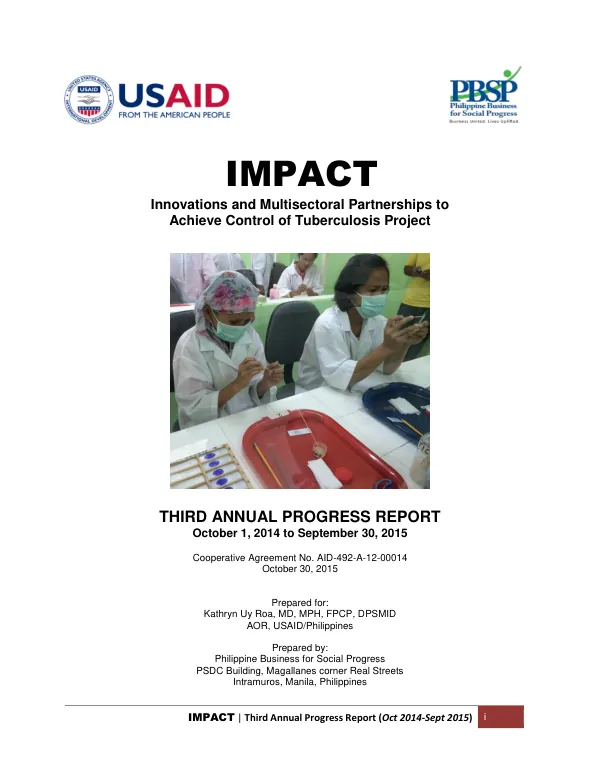
Third Annual Progress Report: Innovations and Multisectoral Partnerships to Achieve Control of Tuberculosis Project
Sign inDEPARTMENT OF HEALTH
Third Annual Progress Report: Innovations and Multisectoral Partnerships to Achieve Control of Tuberculosis Project
The IMPACT Project, a multisectoral partnership to achieve control of tuberculosis, was implemented in the Philippines from October 2014 to September 2015.
2015 · 81 pages
Sign in to readA free account is required to download.
Abstract
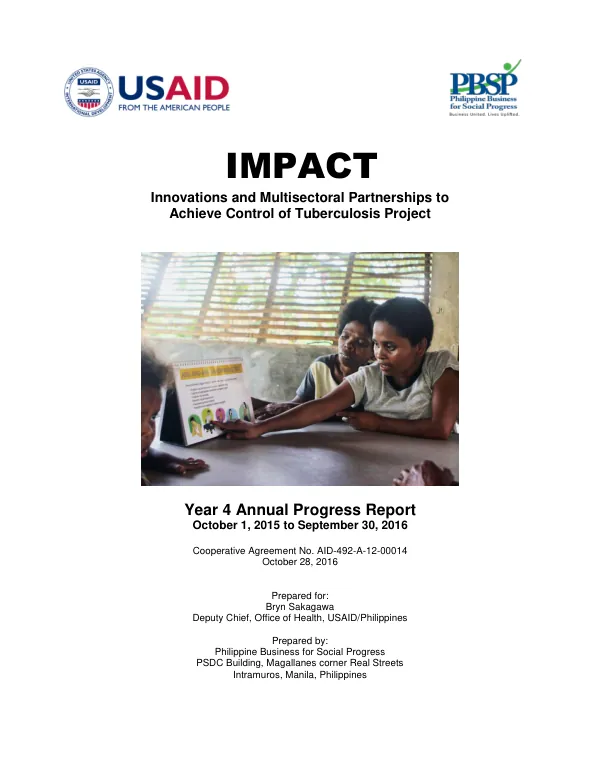
The project's third year witnessed a significant challenge in delivering expected outputs due to reduced funding. To overcome this, the project drew on a robust network of partners, applying innovations and appropriate technologies to engage in finding all TB cases, ensuring all of them are cured, and securing an enabling environment for quality TB control. At the community level, the project engaged and trained indigenous peoples, specifically Aetas in Pampanga, in disseminating TB information and as informal laboratory workers (ILWs). This resulted in easier access to TB diagnosis for 650 Aeta families in 11 villages in the province. To raise the low case detection rate in 31 municipalities in five provinces, the project engaged five non-governmental organizations that helped organize and train community-based organizations (CBOs) in TB case finding. These CBO volunteers reached 23,930 individuals with TB messages, of whom 559 were successfully referred. TB was diagnosed in 168 of the presumptives and were enrolled in treatment. The project also forged a partnership with the Catholic Bishops' Conference of the Philippines – Episcopal Commission on Health Care at the national level, mobilizing 1,396 parish coordinators and volunteers as TB control advocates and "referrers" of TB presumptives in 94 municipalities in nine dioceses. These volunteers reached 2,737 individuals with TB education, identified 374 TB presumptives, and successfully referred 351 of them to DOTS facilities. In this cohort, 77 were found positive for TB and were subsequently enrolled in treatment. To improve drug supply management (DSM) at the regional and provincial levels, the project conducted a DSM trainers' training for Regions 1, 8, and 12, in collaboration with SIAPS. The project also regularly monitored for improvement in DSM in Batangas, Cavite, Laguna, Quezon, and Rizal, which completed the same training in Year 2. To improve patients' adherence to treatment, the project developed a protocol to determine the feasibility, effectiveness, and safety of a 9-month treatment regimen for MDR-TB in the Philippines, in collaboration with NTP, Lung Center of the Philippines−National Center for Pulmonary Research, Global Fund for TB, TASC, and PMDT treatment center (TC) representatives. The project strengthened the capability of regional and LGU NTP teams to plan, manage, implement, monitor, and supervise DOTS service delivery. By the end of Year 3, 25,024 new health workers had been trained in the components of the WHO Stop TB strategy with USG funding. The project also developed an e-Learning course on the NTP MOP, 5th edition, and is currently hosted in the server of Philippine Business for Social Progress. The project continued to work with the DOH–Knowledge Management and Information Technology Service on the full inter-operability of the proposed TB GIS (Geographic Information System) dashboard with the ITIS database. The prototype is now operational and available for viewing at http://itis.doh.gov.ph/login.php. The system uses graphic presentations to track LGUs' NTP performance and achievement of PhilPACT indicators while highlighting hotspots for TB incidence and treatment defaults to facilitate analyses and targeted interventions. Using the learnings from implementing project interventions, the project will craft technical advisories in Year 4 to guide the National TB Control Program in program planning and policy development.