USAID DEC
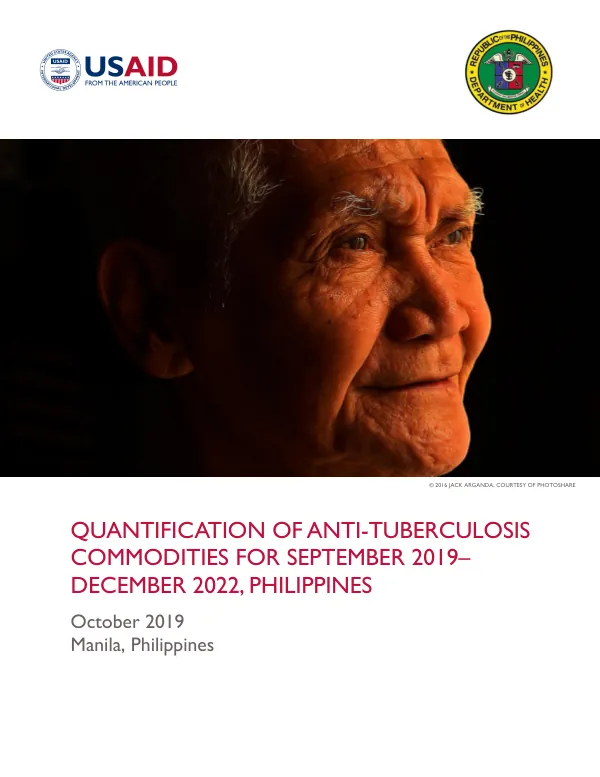
Quantification of Anti-Tuberculosis Commodities for September 2019–December 2022, Philippines
Sign inDEPARTMENT OF HEALTH
Quantification of Anti-Tuberculosis Commodities for September 2019–December 2022, Philippines
The National Tuberculosis Control Program (NTP) is one of the public health programs managed and coordinated by the Public Health Service Team of the Department of Health (DOH) in the Philippines.
2019 · 46 pages
Sign in to readA free account is required to download.
Abstract
The NTP has a mandate to develop TB control policies, standards, and guidelines; formulate the national strategic plan; provide leadership and technical assistance to lower health offices/units; manage data; and monitor and evaluate the performance of the program. The NTP's vision is a TB-free Philippines, with a mission of reducing the TB burden and the catastrophic costs of TB-affected households and responsively delivering TB control services nationwide in collaboration with national, regional, and local government agencies and nongovernmental and international organizations. The USAID Medicines, Technologies, and Pharmaceutical Services (MTaPS) Program aims to enable low- and middle-income countries to strengthen their pharmaceutical systems to ensure sustainable access to and appropriate use of safe, effective, quality-assured, and affordable essential medicines and medicine-related pharmaceutical services. The MTaPS result areas include strengthening pharmaceutical-sector governance; increasing institutional and human resource capacity for pharmaceutical management and services, including regulation of medical products; increasing availability and use of pharmaceutical information for decision making and advancing the global learning agenda; optimizing pharmaceutical-sector financing, including resource allocation and use; and improving pharmaceutical services, including product availability and patient-centered care, to achieve desired health outcomes. The DOH conducts annual quantifications for anti-TB commodities to meet the need of public-sector facilities in the country. The objective of the quantification is to review the current data on program targets, performance, and future strategies to estimate quantities and cost requirements of anti-TB commodities needed for prevention, diagnosis, and treatment for September 2019–December 2022. The morbidity method of quantification and a quantification tool called QuanTB were used to produce results by quantity and value. A procurement plan was developed based on two scenarios—scenario 1 with six-month minimum stock and scenario 2 with one-month minimum stock. The quantification results for first- and second-line anti-TB medicines show that the total procurement value for scenario 1 is $106,666,493, with second-line anti-TB medicines accounting for 46% of the total, first-line anti-TB and LTBI medicines accounting for 38%, and GeneXpert machines accounting for 16%. For scenario 2, the total procurement value is $87,697,107, with second-line anti-TB medicines accounting for 45%, first-line anti-TB and LTBI medicines accounting for 36%, and GeneXpert machines accounting for 19%. The procurement plan includes specific quantities of each product that are required, with a proposed delivery date. The Philippines remains one of 30 high TB burden countries in the world, with an estimated 1 million Filipinos living with active TB and an incidence rate of 554 per 100,000 population. According to the DOH 2016 Annual Report, TB case detection and treatment success rates exceeded the national targets of 93.6% and 90%, respectively. However, TB remains a major health problem in the country and one of the leading causes of mortality. The national target to treat 2.5 million cases by 2022, as committed by the Government of the Philippines at the UN High-Level Meeting on TB, requires continuous availability of anti-TB commodities. The quantification results for GeneXpert machines show that the total procurement value for scenario 1 is $17,169,590, with a requirement of 14 GeneXpert machines in 2019 and 2 machines in 2021. For scenario 2, the total procurement value is $17,169,590, with a requirement of 9 GeneXpert machines in 2019 and 2 machines in 2021. The procurement plan includes specific quantities of each product that are required, with a proposed delivery date. The final result of the quantification exercise was a procurement (supply) plan for September 2019–December 2022, including specific quantities of each product that are required, with a proposed delivery date.
Related documents