USAID DEC
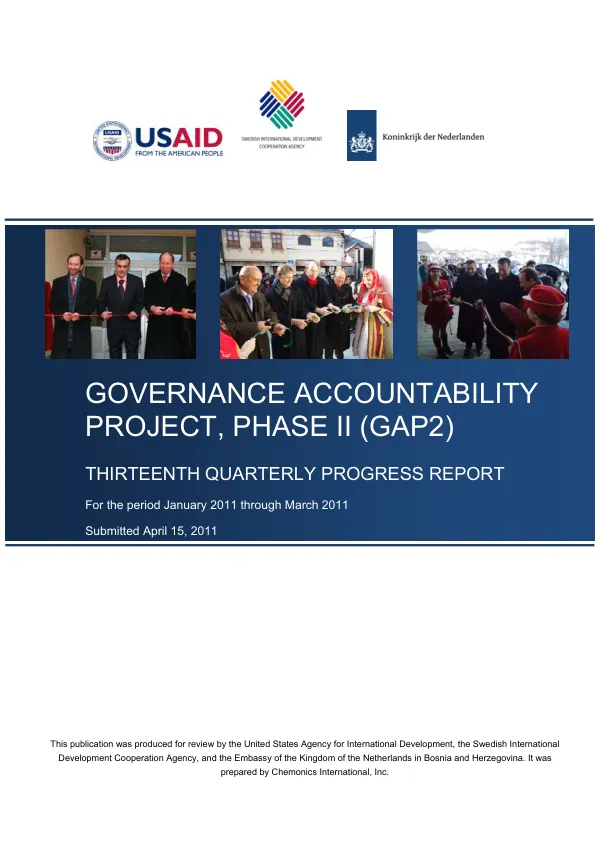
Thirteenth Quarterly Progress Report: Governance Accountability Project, Phase II (GAP2)
Sign inCHEMONICS
Thirteenth Quarterly Progress Report: Governance Accountability Project, Phase II (GAP2)
The Governance Accountability Project, Phase II (GAP2) is a project aimed at promoting excellence in local governance in Bosnia and Herzegovina.
2011 · 39 pages
Sign in to readA free account is required to download.
Abstract
The project is funded by the United States Agency for International Development (USAID), the Swedish International Development Cooperation Agency (Sida), and the Embassy of the Kingdom of the Netherlands in Bosnia and Herzegovina. In the thirteenth quarterly progress report for the period January 2011 through March 2011, GAP2 outlined its Year 4 work plan, which was submitted to the Joint Management Committee (JMC) in November 2010. The project received a formal modification to its scope of work in February, adding new tasks and eliminating several that were no longer feasible. GAP2 held a work planning workshop in February to discuss the detailed implementation approach for the new activities and how best to integrate them with ongoing core activities. The project now seeks to improve municipal management of communal service provision, the functioning of urban planning offices, implementation of municipal youth strategies, and implementation of the State Law on Gender Equality in select pilot municipalities. The modification also includes technical assistance to improve program budgeting at the local level and prepare pilot Federation of Bosnia and Herzegovina (FBiH) municipalities for the introduction of treasury operations as required by the Law on Treasury. During this reporting period, GAP2 initiated a number of new activities, including training events delivered by GAP2 on Local Environment Action Plans, Instrument of Pre-Accession Assistance, document tracking and document imaging, complaints procedure, and advanced features of the Integrated Accounting and Budgeting System (IABS), including treasury. A total of 219 participants, of which 50 percent were women, attended these training events. The Local Interventions team also began implementation of the new tasks added to GAP2's scope of work, including the design of relevant selection criteria and the screening of all partner municipalities in order to short-list candidates for inclusion in various in-depth needs assessments. The assessments will help the project determine the ideal pilot municipalities where success in the targeted areas can most likely be achieved in the remaining two years of the project. Cohort 4 Municipal Action Plan (MAP) scopes of work were prepared, approved by the JMC, and subsequently signed by GAP2 and partner mayors, marking an important project milestone. Now the project can launch direct assistance to the final cohort of GAP2 MAP municipalities. GAP2 reform enabling material assistance allocated to implement the MAP projects set forth in the Statements of Work (SOWs) is approximately 1.5 million KM. The project's new activities are included in the following detailed activity report. The team will also gauge the interest of mayors in participating in informal meetings where they will be able to express common municipal interests regardless of their party or entity affiliation. If interest is high, then GAP2 will organize forums for cooperation. In addition to its core activities, GAP2 will draft a comprehensive exit strategy, formally identifying and preparing various stakeholders to assume ownership of ongoing GAP2 activities following the project's closure. Working through a Memorandum of Understanding (MOU), GAP2 will collaborate closely with the Sida-funded Capacity Development of Municipal Associations (CDMA) project to prepare the two entity Associations of Cities and Municipalities to take over several GAP2 products/activities over the next two years.