USAID
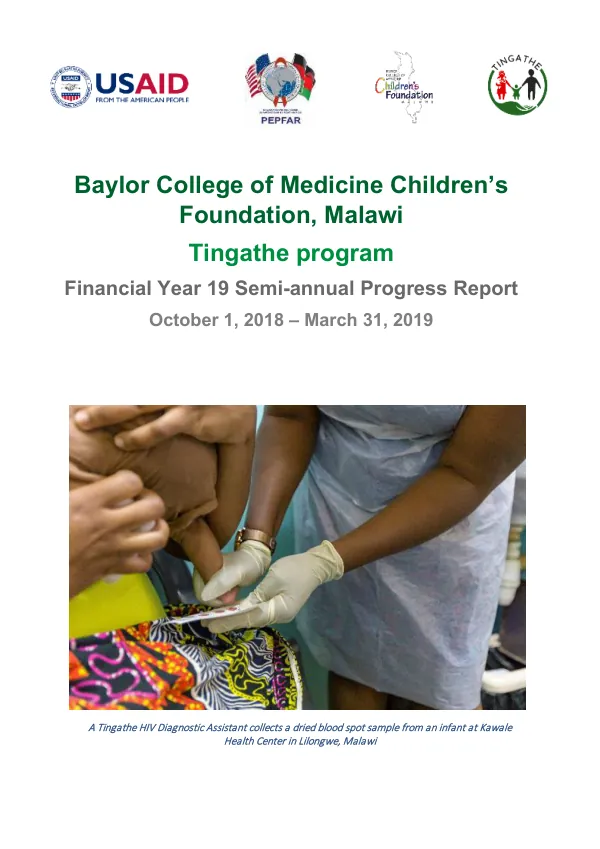
Tingathe Program Financial Year 19 Quarter One (FY19Q1) Progress Report
The Tingathe program is a technical support project to PEPFAR programs in the Southern Africa Region.
2018 · 42 pages
Sign in to readA free account is required to download.
Abstract
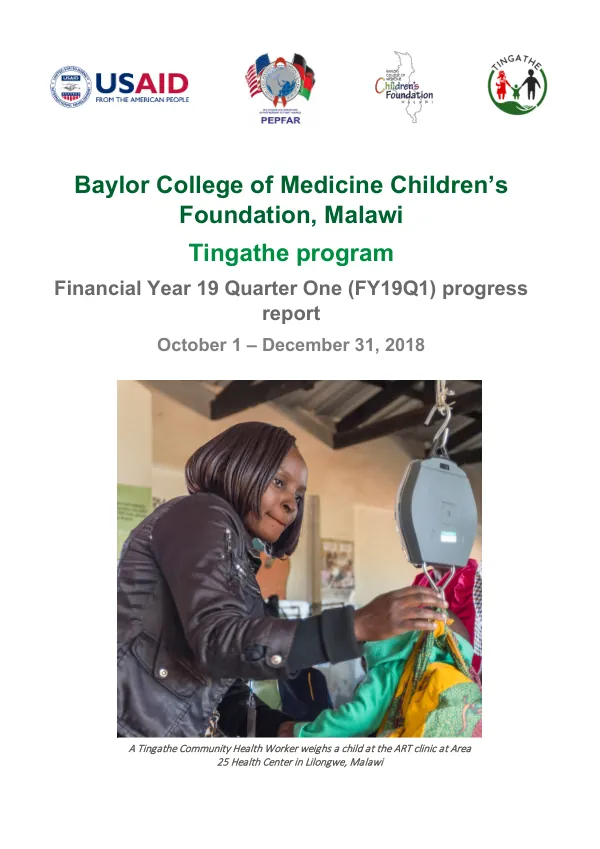
The program is implemented by Baylor College of Medicine Children's Foundation Malawi, with funding from the United States Agency for International Development (USAID). The program's primary goal is to improve HIV testing, treatment, and care services in Malawi. The program operates in seven districts, with a focus on increasing access to HIV testing and treatment, particularly among key populations, including female sex workers and men who have sex with men. The program also targets adolescents and young people, with a focus on improving their access to HIV testing, care, and treatment. One of the key strategies employed by the program is active case finding, which involves testing individuals who are not yet diagnosed with HIV. The program has established a network of community health workers who conduct door-to-door testing and refer individuals who test positive to treatment centers. The program has also implemented provider-initiated testing and counseling, which involves testing individuals who present at health facilities for other reasons. The program has made significant progress in increasing access to HIV testing and treatment. According to the program's quarterly report, the number of individuals tested for HIV increased by 25% in the first quarter of 2019 compared to the same period in 2018. The program also reported a 30% increase in the number of individuals initiated on antiretroviral therapy (ART) during the same period. The program has also made progress in improving retention in care, with a 20% increase in the number of individuals retained in care at six months after initiation of ART. The program has also implemented viral load testing, which has helped to identify individuals who are not adhering to their treatment regimens. In addition to its focus on HIV testing and treatment, the program also provides support for health systems strengthening, including training for healthcare workers and the establishment of clinical centers of excellence. The program also provides support for prevention activities, including gender-based violence prevention and cervical cancer screening. The program's quarterly report highlights several challenges, including the need to improve access to HIV testing and treatment in rural areas and the need to increase the number of individuals retained in care. The program also reports on several successes, including the establishment of a network of community health workers and the implementation of viral load testing. The program's management and operations are overseen by a team of experienced professionals, including a chief of party and a medical director. The program also has a strong monitoring and evaluation system in place, which includes regular reporting and data analysis. Overall, the Tingathe program is making significant progress in improving access to HIV testing and treatment in Malawi. The program's focus on active case finding, provider-initiated testing and counseling, and viral load testing has helped to increase the number of individuals tested for HIV and initiated on ART. The program's commitment to health systems strengthening and prevention activities has also helped to improve the overall quality of care provided to individuals living with HIV in Malawi.